Artificial intelligence is changing how people search for information, compare products, and choose service providers. Businesses now need more than traditional search rankings. They need useful content, clear answers, and reliable information that AI-powered search systems can understand and reference.
Introduction: The Changing Search Landscape
Search engines have changed the way people find information online. Traditional search usually starts with a short keyword. Users receive a list of web pages and visit several websites to find the information they need.
Today, people can ask longer and more detailed questions through ChatGPT, Google Gemini, Perplexity, and AI-powered search features. These systems can interpret a question, retrieve information from different sources, and produce a summarized answer.
This change creates new challenges for website owners. A business must maintain its presence in traditional search results while improving the chance that its content becomes a useful source for AI-generated answers.
A major recent development came on November 12, 2026, when Google announced the global introduction of Gemini 4 Hydrogen in Google Search. Google described improvements in query understanding, query fan-out, visual responses, and access to relevant web sources.
Query fan-out allows a search system to explore several related questions and subtopics at the same time. This helps the system collect broader information before generating a response.
For businesses, this development makes content relevance, technical accessibility, source quality, and brand credibility more important to monitor.
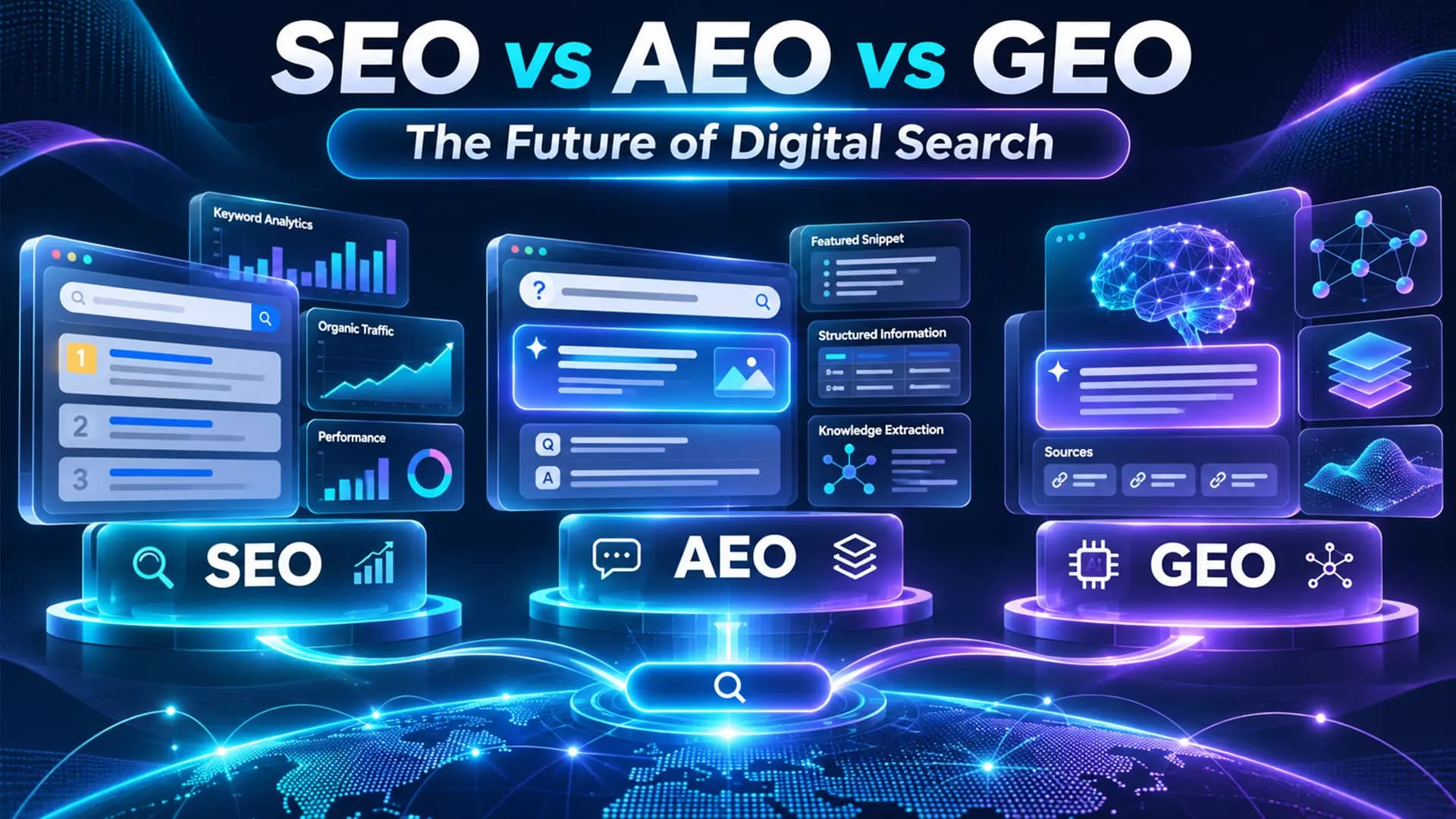
Three terms often appear in discussions about this change: Search Engine Optimization (SEO), Answer Engine Optimization (AEO), and Generative Engine Optimization (GEO). Each term describes a different focus, but businesses can combine all three in one digital strategy.
What Are SEO, AEO, and GEO?
1. Search Engine Optimization (SEO)
Search Engine Optimization is the process of improving a website's visibility in organic search results. SEO helps search engines discover, crawl, understand, index, and evaluate web pages based on their relevance and quality.
SEO includes three main areas. On-page SEO improves page content, titles, headings, internal links, and user experience. Technical SEO helps search engines access and process website pages. Off-page SEO supports website reputation through relevant external links, references, and other credible signals.
For example, a software development company may target keywords such as custom software development, website development company, and mobile app development services.
A well-optimized service page can help potential clients find the company when they search for a relevant technology solution.
2. Answer Engine Optimization (AEO)
Answer Engine Optimization is an approach to preparing website content so answer-focused search systems can identify and present useful information in response to user questions.
AEO focuses on the questions people ask. Content should provide clear, accurate, direct answers with enough context to help readers understand the subject.
This approach is relevant to featured snippets, direct answer results, voice search, and AI-powered answer experiences.
Consider a user who asks, "What is the difference between a company website and a web application?" An article that explains both concepts in a clear and structured way can help users find the right answer.
Businesses can improve answer-focused content by using descriptive headings, relevant FAQs, accurate definitions, examples, and concise explanations.
3. Generative Engine Optimization (GEO)
Generative Engine Optimization is an approach to improving the chance that a brand's content and information will become a source in AI-generated responses.
Generative systems such as ChatGPT, Gemini, and Perplexity can combine information from multiple sources. They then produce responses based on the relevance of the available information to a user's question.
GEO encourages businesses to publish useful content, establish clear brand information, demonstrate real expertise, and support important claims with reliable sources.
For example, a user may ask an AI platform to recommend software development companies that build business applications. Clear company profiles, detailed service pages, genuine project portfolios, and useful technical articles can help AI systems understand a company's services and expertise.
However, GEO does not guarantee a recommendation or citation. Each AI platform uses different systems to retrieve, evaluate, and present information.
SEO vs AEO vs GEO: Key Differences
These three approaches support different forms of digital visibility. Their main differences relate to the search experience they target and the metrics businesses use to evaluate performance.
| Aspect | SEO | AEO | GEO |
|---|---|---|---|
| Main focus | Search rankings | Direct answers | AI references |
| Target system | Search engines | Answer engines | Generative engines |
| Content focus | Relevant and useful | Clear and direct | Detailed and trustworthy |
| Key indicators | Rankings and clicks | Answer visibility | Citations and mentions |
| Business goal | Organic traffic | Relevant answers | AI visibility and trust |
Businesses do not need to choose one approach and abandon the others. SEO provides the technical and content foundation. AEO improves how content answers user questions. GEO expands the focus to how generative systems retrieve and reference brand information.
Google also confirms that established SEO practices remain relevant to AI Overviews and AI Mode. Websites still need to meet search technical requirements, provide useful content, and make information accessible to users and search systems.
Latest AI Search Developments: Google and Microsoft
Google Introduces Gemini 4 Hydrogen in Search
On November 12, 2026, Google announced Gemini 4 Hydrogen for Google Search users worldwide. Google described improvements in complex query understanding, query fan-out, visual responses, and links to useful web sources.
The updated system can explore several related searches at once. This allows Search to identify relevant information across a wider range of subtopics.
This development gives businesses a reason to improve their keyword research. Content teams should understand the main question, follow-up questions, product comparisons, and information needs that influence buying decisions.
However, a model upgrade does not automatically mean that Google has changed every ranking factor. Businesses should separate confirmed product changes from assumptions about ranking algorithms.
Source: Google Search gets a major upgrade with Gemini 4 Hydrogen, November 12, 2026.
Microsoft Introduces Topics Portfolio in Bing Webmaster Tools
On October 13, 2026, Microsoft announced Topics Portfolio in beta within Bing Webmaster Tools. The feature groups grounding queries into broader topic clusters.
Website owners can review the topics where their content already appears in AI answers. They can also identify queries where other websites appear as sources but their own pages do not.
The report includes indicators such as Topic Size, Sites Cited, and Queries. Microsoft also explains that some values are estimates and topic classification uses AI. Users should treat these results as planning signals rather than exact measurements.
This update shows how AI visibility measurement is developing. Website owners can move beyond simple brand checks and study the topics, pages, and query opportunities connected to AI citations.
Source: Microsoft Bing Webmaster Tools, Introducing Topics Portfolio (Beta), October 13, 2026.
Why Businesses Need to Measure SEO, AEO, and GEO
Many businesses invest in digital optimization without a clear measurement process. They publish articles, update service pages, and monitor website visitors. However, these activities do not always show whether the strategy supports business goals.
Measurement helps businesses understand the relationship between marketing activity, user behavior, and business results. Without reliable data, teams may make decisions based on assumptions.
A useful measurement process follows five stages: data collection, data cleaning, metric selection, pattern analysis, and action planning.
Stage 1: Collect Data from Relevant Sources
Start by choosing data sources that match the purpose of the analysis. SEO, AEO, and GEO do not rely on exactly the same information. A complete measurement process therefore combines several tools.
Google Search Console
Google Search Console provides information about organic search performance. Teams can review impressions, clicks, click-through rate, average position, queries, and landing pages.
These metrics help businesses identify which search terms generate visibility, which pages attract visitors, and which queries need further optimization.
Google Analytics 4
Google Analytics 4 helps businesses understand what visitors do after they reach a website. Teams can examine sessions, engagement, traffic sources, key events, and conversions.
Businesses can connect these metrics to outcomes such as consultation requests, form submissions, phone calls, qualified leads, and sales.
Bing Webmaster Tools
Bing Webmaster Tools provides information about crawling, indexing, and search performance. Its AI Performance report adds information about website pages cited in supported AI-generated answers across Microsoft experiences.
Available indicators include total citations, average cited pages, grounding queries, and URL-level citation activity. Businesses can use these signals to identify content that already serves as a reference.
AI Search Testing and Brand Monitoring
Teams should also test relevant questions in ChatGPT, Gemini, and Perplexity. Use a consistent list of questions to check whether the brand appears, whether the website becomes a source, and whether the platform presents accurate company information.
Record the test date, platform, query, brand mentions, source URLs, and response context. Manual testing cannot represent every possible AI answer. However, it can provide an initial view of brand visibility.
Stage 2: Clean and Organize the Data
Raw data often contains duplicate records, inconsistent dates, tracking parameters, and different URL formats. Teams should clean this information before drawing conclusions.
For example, a website may have several URLs with tracking parameters. If an analyst treats every URL as a separate page, the report may overstate the number of unique landing pages.
A practical data-cleaning process includes:
- Identify duplicate records and repeated URLs.
- Standardize dates and reporting periods.
- Group URLs into service pages, articles, and category pages.
- Separate branded and non-branded search queries.
- Classify queries by search intent.
- Segment data by country, language, device, and traffic source.
- Record website changes and relevant search updates.
Analysts should also avoid combining metrics with different definitions. A click in Google Search Console is not the same as a session in Google Analytics 4. One user can generate multiple sessions, and attribution differences can produce different totals.
GEO analysis requires clear distinctions between brand mentions, citations, and referrals. A brand mention means an AI response names the company. A citation means the response uses a page as a source. A referral means a visitor reaches the website from an AI platform.
These indicators describe different activities and should not be treated as interchangeable.
Stage 3: Define SEO, AEO, and GEO Metrics
Once the data is clean, businesses need metrics that match their goals. Each metric should explain whether a strategy improves visibility, engagement, or business performance.
SEO Performance Metrics
- Organic clicks: visits generated from organic search results.
- Impressions: the number of times a page appears in search results.
- Click-through rate: the share of impressions that produce clicks.
- Average position: the average search position of a page or query.
- Organic sessions: website sessions from organic search.
- Organic conversion rate: the percentage of organic sessions that produce a conversion.
AEO Performance Metrics
- Coverage of informational queries answered by website content.
- Featured snippet and direct-answer appearances across a defined query sample.
- Number of user questions addressed by relevant pages.
- Answer relevance and accuracy.
- Changes in clicks and conversions from answer-focused pages.
There is no single universal AEO measurement standard across all answer engines. Businesses should define their own testing method, query sample, and data sources. They should also record these definitions so future reports remain comparable.
GEO Performance Metrics
- AI citations: the number of times website pages appear as sources in AI answers.
- Cited pages: the number of unique website URLs referenced by AI systems.
- Brand mentions: the number of brand references across a defined answer sample.
- Grounding queries: queries associated with source retrieval activity.
- AI referral sessions: visits from AI platforms to the website.
- AI-assisted conversions: conversions involving AI-related discovery, where attribution data supports the measurement.
Businesses should connect these metrics to commercial outcomes. Higher visibility does not always produce more revenue. Qualified leads, acquisition costs, and transaction value still matter.
Stage 4: Analyze Patterns and Identify Opportunities
Individual numbers rarely explain the full situation. Teams should compare periods, page groups, query types, and conversions to identify meaningful patterns.
Pattern 1: Impressions Increase but Clicks Decline
This pattern may indicate that pages appear more often but attract fewer visits. Possible causes include ranking changes, weak titles, stronger competitors, SERP layout changes, or direct answers that satisfy users without a website visit.
Teams should examine the affected queries, average positions, device segments, and search result features before making changes.
Pattern 2: AI Brand Mentions Increase but Referrals Remain Low
AI systems can mention a company without sending visitors to its website. Users may receive enough information from the generated response and decide not to click.
This does not automatically mean that GEO has failed. However, businesses should check whether the information is accurate and whether AI visibility leads to branded searches, consultation requests, or sales through other channels.
Pattern 3: High Traffic but Low Conversions
This pattern may reveal a mismatch between search intent and page content. Visitors may want basic information, while the page focuses only on selling a service.
Businesses can improve the page by explaining customer problems, adding relevant case studies, showing the service process, and using a call to action that matches the visitor's decision stage.
Pattern 4: AI Citations Concentrate on a Few Articles
If only a few articles receive frequent AI citations, teams should examine their characteristics. These pages may provide clear definitions, verifiable data, useful examples, and stronger topic coverage.
The findings can guide improvements to other pages. However, teams should not copy the same content across multiple URLs. Each page should answer a distinct user need.
Stage 5: Take Action Based on the Findings
Analysis creates value when businesses use the findings to improve their strategy. Each action needs a clear priority, an owner, and a measurable outcome.
For example, a business may discover that a service page has many impressions but a low click-through rate. The team can test a new title tag and meta description. It can then compare performance before and after the change across relevant reporting periods.
If an article receives AI citations but lacks important information, the team can add supporting data, official references, practical examples, and more specific explanations.
Businesses can also strengthen internal linking. An educational article can link to an implementation guide and a related service page. This helps users explore the topic while giving search systems a clearer view of the site's content relationships.
A Practical 30-Day Optimization Plan
| Period | Activities | Expected Output |
|---|---|---|
| Days 1–7 | Audit SEO, indexing, queries, and page performance. | Website performance baseline. |
| Days 8–14 | Research user questions and test AI search visibility. | AEO and GEO opportunity map. |
| Days 15–21 | Improve content, page structure, and internal links. | Better content quality. |
| Days 22–30 | Measure results and review conversions. | Next optimization plan. |
This plan provides an initial measurement cycle. Businesses should repeat the process because search behavior, content competition, and website performance can change over time.
Common Mistakes in SEO, AEO, and GEO
Treating GEO as a Replacement for SEO
GEO does not remove the need for SEO. Websites still need crawlable pages, clear structures, useful information, and reliable technical foundations.
Publishing AI Content Without Review
AI tools can help teams research and draft content. However, people still need to verify facts, references, context, and accuracy. Articles that repeat common information without adding useful insight offer limited value.
Chasing Citations Instead of Content Quality
Citation volume cannot replace lead quality or customer satisfaction. Businesses should make sure AI systems receive accurate information about their actual services, experience, and capabilities.
Using Metrics Without Clear Definitions
Teams need consistent definitions for citations, mentions, referrals, conversions, and organic traffic. Inconsistent definitions can produce misleading reports and poor decisions.
Relying on a Single AI Search Test
AI responses may change based on context, time, location, and query wording. Teams should use a consistent query sample and testing schedule. One response cannot prove that a brand has stable AI search visibility.
How Businesses Can Integrate SEO, AEO, and GEO
Businesses need an integrated strategy that reflects their market, customers, and services. Local companies can combine location-based keywords, accurate business information, service pages, and genuine project portfolios.
Companies targeting national or international markets should also consider language, URL structure, hreflang implementation, customer needs, and source relevance.
PT Code Hero Indonesia can support this strategy through three connected areas of work. The first is building a fast, secure, and accessible website. The second is developing content that answers user questions. The third is measuring performance through search data, website analytics, and AI visibility testing.
Businesses should also build topical authority through related articles. An article about SEO can connect to technical SEO, AEO, GEO, analytics, and content strategy.
This structure helps visitors explore a subject in greater depth. It also gives search systems clearer signals about the relationships between website topics.
The Role of Website Technology in AI Search
High-quality content needs a website that can deliver it effectively. Slow pages, inaccessible resources, inconsistent URLs, and indexing problems can limit search visibility.
Businesses should review Core Web Vitals, mobile responsiveness, HTTPS security, heading structure, XML sitemaps, canonical URLs, and internal links.
Structured data can help search engines interpret specific information when the markup accurately reflects visible page content. However, structured data does not guarantee an AI citation.
Google also explains that website owners do not need to create llms.txt files or split every article into small chunks to appear in Google's AI search features. Businesses should focus on useful content and sound technical SEO practices.
Website development and SEO should therefore work together. Businesses need technical architecture that supports user needs, content management, and long-term growth.
Conclusion: Build Search Visibility Through Data and Strategy
SEO, AEO, and GEO represent three important areas in the changing search landscape. SEO helps websites gain visibility in search results. AEO helps content provide relevant answers. GEO helps businesses improve their understanding of how generative systems retrieve and reference online information.
Businesses should not treat these approaches as replacements for one another. They can combine them through strong technical foundations, useful content, clear brand information, and consistent measurement.
Effective decisions also require a systematic process. Businesses should collect data, clean information, define metrics, analyze patterns, and take action based on evidence.
This approach helps companies evaluate digital performance beyond search rankings. They can understand the quality of user engagement and how search visibility contributes to business goals.
Frequently Asked Questions About SEO, AEO, and GEO
What is the main difference between SEO, AEO, and GEO?
SEO focuses on website visibility in search results. AEO focuses on providing direct answers to user questions. GEO focuses on improving the chance that brand information and website content become sources in generative AI responses.
Can GEO replace traditional SEO?
No. GEO still benefits from crawlable pages, useful content, clear website structures, and reliable technical foundations. SEO remains an important part of AI search visibility.
How can a business measure GEO performance?
Businesses can track AI citations, cited pages, brand mentions, grounding queries, AI referral sessions, and conversions connected to AI discovery. Each metric needs a consistent definition and collection method.
Can every website appear in ChatGPT and Gemini answers?
There is no guarantee. Visibility depends on each platform's systems, source relevance, content quality, page accessibility, and the context of the user's question.
Do small businesses need SEO, AEO, and GEO?
Small businesses can start with technical SEO, accurate company information, useful answers to customer questions, and basic performance tracking. They do not need to implement every activity at once.
How long does it take to see SEO and GEO results?
There is no fixed timeline. Technical conditions, competition, content quality, brand reputation, and update frequency can all influence visibility growth.
References and Sources
- Google. (November 12, 2026). Google Search gets a major upgrade with Gemini 4 Hydrogen.
- Microsoft Bing Webmaster Blog. (October 13, 2026). Introducing Topics Portfolio (Beta) in AI Performance.
- Google Search Central. (May 15, 2026). A new resource for optimizing for generative AI in Google Search.
- Google Search Central. Optimizing your website for generative AI features on Google Search.
- Aggarwal, P., et al. (2024). GEO: Generative Engine Optimization. ACM SIGKDD 2024.
- Microsoft Bing Webmaster Blog. (February 10, 2026). Introducing AI Performance in Bing Webmaster Tools Public Preview.
Improve Your Business Search Visibility with PT Code Hero Indonesia
Changes in search technology make it important for businesses to review their website and SEO strategy. Strong technical foundations, useful content, and data-driven measurement can help companies build sustainable digital visibility.
PT Code Hero Indonesia provides professional SEO services to help businesses improve website quality, search structure, and digital visibility based on their business needs.
Explore Professional SEO Services