Generative Engine Optimization helps businesses improve the chances that their content, brand information, and expertise will become sources in AI-generated answers. Learn how GEO works, which strategies matter, how to measure AI citations, and how to build a practical optimization plan.
Introduction: Why Generative Engine Optimization Matters
Artificial intelligence is changing how people search for and use information. In traditional search, users enter keywords into Google, review a list of results, and visit several websites to find an answer. Today, they can ask ChatGPT, Google Gemini, and Perplexity direct questions and receive structured responses.
This shift changes digital marketing. Websites still need to compete for organic search rankings. However, brands also need to make their company information, products, and services understandable to AI-powered search systems.
This development has increased interest in Generative Engine Optimization, or GEO. The approach focuses on improving the chances that website content and brand information will serve as references in generative AI responses.
Recent developments show how quickly this search environment is changing. On November 12, 2026, Google announced Gemini 4 Hydrogen for Google Search globally. Google described improvements in complex query understanding, query fan-out, and the presentation of visual answers and supporting sources.
Microsoft also introduced Topics Portfolio in beta within Bing Webmaster Tools on October 13, 2026. The feature helps website owners review topic groups connected to AI citations and identify query opportunities.
These developments make AI visibility an important part of website management. Businesses need to understand how AI systems discover sources, process information, and generate answers.
GEO provides a framework for addressing these needs. However, businesses should apply it through evidence, content quality, and consistent measurement rather than relying on unverified optimization tactics.
What Is Generative Engine Optimization (GEO)?
Generative Engine Optimization is an approach to improving digital content and brand information so that a website has a better chance of becoming a source in AI-generated responses.
Generative systems can retrieve information from different sources, process the context of a question, and produce an answer using artificial intelligence models. Some platforms also display source names and links to the pages that support their responses.
GEO helps businesses improve the quality and clarity of their information. This includes company identity, areas of expertise, products, services, and supporting evidence.
For example, someone may ask ChatGPT, "Which companies provide business application development services?"
To answer this question, an AI system may retrieve information from service pages, technical articles, business directories, documentation, and other relevant sources. A company with clear and consistent information may have a better opportunity to become one of the sources.
However, GEO does not guarantee that a brand will appear in every response. Each platform uses different methods to retrieve information, interpret context, and generate answers.
GEO vs Traditional SEO
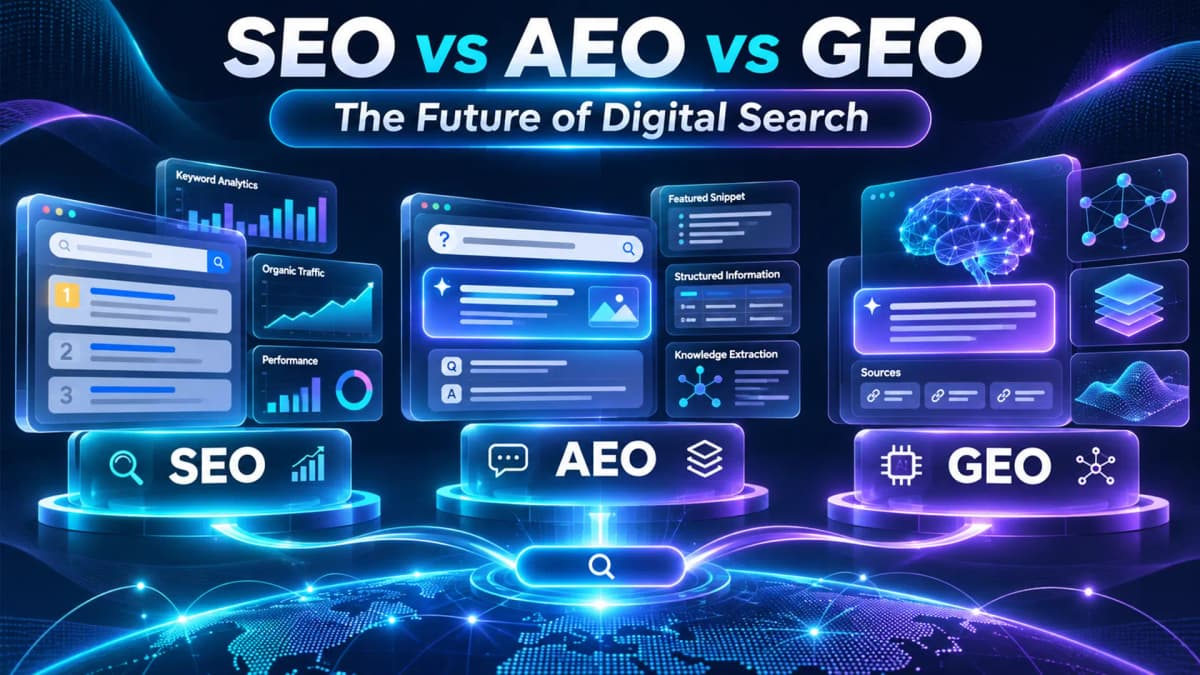
Traditional SEO focuses on improving website visibility in organic search results. GEO expands the focus to how generative systems use online content as references in their answers.
| Aspect | SEO | GEO |
|---|---|---|
| Main goal | Improve search result visibility. | Improve the chance of becoming an AI answer source. |
| Platforms | Google, Bing, and search engines. | ChatGPT, Gemini, Perplexity, and AI search experiences. |
| Content focus | Keyword relevance and search intent. | Clear information, context, evidence, and credibility. |
| Key metrics | Rankings, impressions, clicks, and traffic. | AI citations, brand mentions, cited pages, and referrals. |
| Business outcome | Organic visits and leads. | Brand visibility in AI answers and discovery opportunities. |
These differences do not mean GEO replaces SEO. Google explains that its AI search features still rely on core search ranking and quality systems. Businesses therefore need technical SEO, useful content, and websites that search crawlers can access.
How Does Generative Engine Optimization Work?
GEO requires an understanding of what happens when a user asks a generative search system a question. Although each platform uses different technologies, several concepts help explain the process.
1. Understanding User Intent
AI systems process questions to identify the user's context and information needs. A simple question may require a short answer. A complex question may require several types of information.
For example, the question "How should a manufacturing company choose a software development partner?" may involve industry experience, technology, cost, security, and implementation methods.
Businesses should therefore understand the main questions customers ask and the supporting information they need before making decisions.
2. Retrieving Relevant Information
Some AI search experiences use retrieval-augmented generation, commonly known as RAG. This approach combines generative models with information retrieved from external sources or search indexes.
Google explains that its AI search features can use RAG to retrieve relevant pages from the Search index. The system then uses information from those pages to generate more accurate and current responses.
This makes page quality, information clarity, and website accessibility important areas for GEO.
3. Expanding Search Through Query Fan-Out
Query fan-out is an approach that expands one question into several related searches. The system explores different subtopics to collect information that supports a more complete response.
For example, a question about GEO strategy may lead to related searches about AI citations, content authority, brand mentions, technical SEO, and AI search analytics.
Google describes query fan-out as part of its AI search approach. Its November 2026 Gemini 4 Hydrogen announcement also highlights improvements to this capability.
4. Generating Answers and Showing Sources
After retrieving information, the generative system creates a response based on the user's question and available sources. Some platforms include citations or links to supporting pages.
A website may gain visibility when its information is relevant and supports the answer. However, website owners cannot fully control which sources an AI platform selects.
GEO should therefore focus on source quality, consistent information, and user needs. Strategies that pursue brand mentions without supporting accurate information have limited long-term value.
Latest GEO and AI Search Developments in 2026
Google Expands AI Search with Gemini 4 Hydrogen
On November 12, 2026, Google announced Gemini 4 Hydrogen for Google Search users worldwide. The update brings improvements in user intent understanding, query fan-out, and visual response formats.
Google also explained that Search can run several related searches at the same time to discover a wider range of useful sources. A question may therefore involve more than one keyword or a single page with an exact phrase match.
For GEO practitioners, this development reinforces the need for relevant topic coverage. Businesses should answer the main question and provide supporting information that helps users understand the subject.
Microsoft Develops AI Citation Measurement
In February 2026, Microsoft introduced AI Performance in Bing Webmaster Tools as a public preview. The feature provides information about website pages cited in AI-generated answers across Microsoft Copilot, AI-generated summaries in Bing, and selected partner integrations.
Website owners can review total citations, average cited pages, grounding queries, and URL-level citation activity. These metrics help businesses understand which pages serve as references in generative responses.
On October 13, 2026, Microsoft expanded this reporting approach with Topics Portfolio in beta. The feature groups grounding queries into broader topics and identifies queries where other websites appear as sources but the user's website does not.
Microsoft notes that some values are estimates and AI generates the topic classification. Businesses should therefore treat the data as planning signals rather than exact measurements.
Google Reinforces the Importance of SEO Foundations
On May 15, 2026, Google published a guide to help website owners understand how to optimize for generative AI features in Google Search. The guide emphasizes unique content, real experience, information quality, and technical website foundations.
Google also explains that website owners do not need to create llms.txt files, divide all content into tiny sections, or add special markup to appear in Google's AI search features.
This guidance matters because some GEO advice still promotes tactics without clear technical support. Businesses should distinguish evidence-based recommendations from marketing claims about optimization tools.
Generative Engine Optimization Strategies for Businesses
Businesses should apply GEO based on their customers, products, services, and commercial goals. A strong strategy does more than increase brand appearances in AI answers. It creates reliable information that people and search systems can use.
1. Create Content That Provides Real Value
Content is a central part of GEO. Articles that repeat common information have limited differentiation. Businesses should publish experience, analysis, data, case studies, and explanations that reflect their actual expertise.
For example, a software development company can publish articles about ERP implementation, database integration challenges, application security, and software development costs.
This content provides more specific information than a general article that only defines software development.
2. Use a Clear Content Structure
A clear structure helps readers find information quickly. Use one H1 for the main topic, H2 headings for major sections, and H3 headings for supporting subjects.
Each section should address a specific question. Use definitions, tables, lists, examples, and FAQs when they help readers understand the topic.
A clear structure does not mean every article must contain many short and disconnected paragraphs. The depth and length should match the subject and the reader's needs.
3. Strengthen Brand Identity and Information Consistency
AI systems need to understand the entities described in online content. Businesses can clarify their identity through About Us pages, service pages, company profiles, addresses, contact details, portfolios, and organization information.
Keep company names, service descriptions, product details, and contact information consistent across official channels.
Consistent information reduces ambiguity when users search for a company. However, it does not guarantee that an AI platform will select the brand as a source.
4. Support Claims with Verifiable Sources
Important claims should include supporting evidence. Use official documentation, academic research, industry data, company reports, and project experience that readers can verify.
Avoid publishing statistics, testimonials, or case studies without evidence. Inaccurate information can damage user trust and business reputation.
5. Build Topical Authority
Topical authority relates to the depth and consistency of a website's coverage in a specific subject area. Businesses can build a group of connected articles that support one another.
A technology company, for example, can create content around software development, website development, cybersecurity, cloud computing, and digital transformation.
Each article should serve a clear purpose. Internal links connect related pages and help visitors find additional information.
6. Build a Reputation on Relevant External Sources
Company information does not exist only on an official website. Users may also discover a brand through industry publications, business directories, professional communities, customer reviews, and third-party reports.
Businesses should build their reputation through accurate information and relevant contributions. Avoid mass-produced brand mentions, fake reviews, and low-quality link networks.
Google specifically advises website owners not to pursue inauthentic mentions as a GEO tactic.
7. Improve Technical SEO and Website Accessibility
A website should provide reliable access for both users and search systems. Businesses need to ensure that important pages can be crawled, indexed, and processed correctly.
- Use HTTPS and appropriate security settings.
- Maintain an updated XML sitemap.
- Check robots.txt and page indexing status.
- Use a consistent URL structure.
- Improve page speed and mobile experience.
- Use appropriate headings and semantic HTML.
- Implement structured data when it accurately reflects visible content.
- Build internal links that support website navigation.
Technical SEO does not guarantee AI citations. However, a sound technical foundation helps search systems discover and process website information.
How to Measure Generative Engine Optimization Performance
GEO requires a consistent measurement process. Businesses should not only check whether ChatGPT or Gemini mentions their brand. They also need to understand the source, query type, cited page, and contribution to business goals.
A practical measurement process follows five stages: data collection, data cleaning, metric selection, pattern analysis, and action planning.
Stage 1: Collect Data
Use several data sources so the analysis does not depend on one platform.
- Bing Webmaster Tools: review AI citations, cited pages, and grounding queries through AI Performance.
- Google Search Console: monitor impressions, clicks, CTR, queries, and search performance. Use any available generative AI reporting for eligible properties.
- Google Analytics 4: analyze referral sessions, engagement, and conversions.
- ChatGPT, Gemini, and Perplexity: test relevant questions and observe brand mentions and source links.
- CRM: connect lead sources with consultation requests and sales outcomes.
When testing AI platforms, use a consistent question set. Record the date, platform, query, brand appearance, source URL, and answer context.
Stage 2: Clean and Organize Information
Raw data may contain duplicate records and inconsistent formats. Teams should standardize the information before creating reports.
- Remove duplicate URL records.
- Standardize dates and reporting periods.
- Group pages by topic and service.
- Separate brand mentions from citations.
- Separate AI referrals from organic search traffic.
- Classify queries by user intent.
- Mark data collected through manual testing.
Teams should not treat brand mentions, page citations, and referral visits as the same indicator. Each metric describes a different activity.
Stage 3: Define GEO Metrics
Businesses should select metrics that explain changes in visibility and business performance.
| Metric | Definition | Measurement Purpose |
|---|---|---|
| AI Citations | Website citations in AI-generated responses. | Measure content usage as a source. |
| Cited Pages | Unique website pages referenced by AI. | Understand content visibility distribution. |
| Brand Mentions | Brand appearances across a defined answer sample. | Measure brand visibility. |
| Grounding Queries | Queries associated with AI source retrieval. | Understand information needs. |
| AI Referral Sessions | Website sessions from AI platforms. | Measure visits generated by AI discovery. |
| AI-assisted Conversions | Conversions involving AI interactions. | Connect visibility with business outcomes. |
Businesses should define each metric before using it in a report. For example, a brand mention rate can use the same query sample every month. This makes comparisons more reliable without claiming that the sample represents every AI-generated response.
Stage 4: Analyze Data Patterns
Teams should compare data by period, topic, page, and platform. The purpose is to identify changes that matter to the business strategy.
For example, AI citations may increase for educational articles while service pages receive little referral traffic. This pattern may suggest that the business has useful informational content but has not connected it effectively to customer needs and commercial pages.
Another example occurs when an AI platform frequently mentions a brand but provides inaccurate pricing or service details. The business should review its website information and external company profiles.
Teams should also identify topics with limited website coverage. These opportunities may come from queries that appear in AI source retrieval but do not have supporting articles on the website.
Stage 5: Take Action
Each finding should lead to an action that the team can test. If a page receives frequent citations, the business can update its information and strengthen internal links. If a page lacks visibility, the team can review its topic relevance, content quality, and technical condition.
Prioritize tasks based on business impact, implementation effort, and available evidence. Avoid changing every page at once without understanding the main problem.
Practical GEO Implementation for a Business
Consider a technology company that wants to improve its chances of appearing in AI answers when people search for software development services.
The company can begin by identifying common customer questions. These may include software development costs, technology selection, website development processes, application security, and the differences between custom software and ready-made products.
The company can then group these questions by user intent and create a relevant content structure.
| Topic | Content | Purpose |
|---|---|---|
| Software costs | Factors that affect software development costs. | Answer early information needs. |
| Development process | Stages of business application development. | Explain the company's working process. |
| Security | Application security and data management principles. | Build trust. |
| Vendor selection | How to choose a software development company. | Support purchasing decisions. |
| Services | Software development service page. | Connect information with business services. |
The company should then improve its About Us page, team profiles, project portfolio, service pages, and contact information. Every page should provide accurate and consistent information.
Next, the team can test relevant questions across several AI platforms. It should record brand mentions, citations, source URLs, and the accuracy of the information.
These findings can guide future content improvements. This process helps businesses develop GEO based on market needs rather than assumptions about how AI works.
Common GEO Mistakes Businesses Should Avoid
Assuming GEO Guarantees AI Recommendations
No optimization strategy can guarantee that a brand will appear in every AI response. Businesses should measure visibility opportunities and improve source quality over time.
Publishing Large Volumes of Content Without Added Value
Publishing more articles does not automatically improve reputation. Content should answer user needs and provide information beyond common knowledge.
Using Inconsistent Company Information
Different company names, services, prices, locations, and contact details can confuse users. Businesses should manage official information across their digital channels.
Chasing Inauthentic AI Mentions
Fake brand mentions and purchased reviews do not build a reliable reputation. Businesses should focus on customer experience, quality publications, and verifiable information.
Measuring GEO Through One Platform Only
ChatGPT, Gemini, Perplexity, and other AI search systems can produce different answers. Businesses should use multiple platforms and record the limitations of each data source.
A 90-Day GEO Roadmap for Businesses
Businesses can begin GEO implementation through a 90-day roadmap. This schedule provides an example of project planning. It does not guarantee visibility results within that period.
| Period | Focus | Activities | Output |
|---|---|---|---|
| Days 1-30 | Audit and baseline | Website audit, query research, AI testing, and brand information review. | Initial performance report. |
| Days 31-60 | Content optimization | Page improvements, content development, internal linking, and company information updates. | Improved website content and structure. |
| Days 61-90 | Measurement and evaluation | Monitor citations, mentions, referrals, and topic opportunities. | Performance review and next priorities. |
After 90 days, businesses should compare the results with their initial baseline. The review should consider content quality, citation distribution, website traffic, and conversions.
Why Businesses Need GEO and SEO Together
GEO and SEO are closely connected. SEO helps search engines discover and understand a website. GEO expands the strategy by considering how generative systems retrieve and reference business information.
Both approaches benefit from useful content, clear website structures, accurate information, and a good user experience.
A business that focuses only on GEO without technical SEO may face crawling and indexing problems. A business that focuses only on rankings may overlook how its brand appears in AI-generated answers.
A complete digital strategy should combine SEO foundations, content quality, brand reputation, and AI search measurement. This approach helps businesses build visibility across different discovery channels.
Frequently Asked Questions About Generative Engine Optimization
What is Generative Engine Optimization (GEO)?
GEO is an approach to optimizing digital content and brand information so a website has a better chance of becoming a source in generative AI answers from platforms such as ChatGPT, Gemini, and Perplexity.
What is the main goal of GEO?
GEO aims to improve brand and content visibility in AI-generated answers, clarify brand identity, and support information discovery by potential customers.
How is GEO different from SEO?
GEO focuses on the opportunity to become a source in AI answers, while SEO focuses on website visibility in search results. Both approaches support one another and require strong content and technical foundations.
How can a website appear in ChatGPT answers?
Businesses can improve content quality, maintain accessible pages, clarify brand information, use verifiable sources, and build a reliable digital reputation. However, no method guarantees that ChatGPT will mention a specific website in every response.
Does GEO require an llms.txt file?
Google states that llms.txt is not required for visibility in Google's generative AI search features. Businesses should review each platform's requirements before implementing special files or technical methods.
What are the main GEO performance metrics?
Useful metrics include AI citations, cited pages, brand mentions, grounding queries, AI referral sessions, and AI-assisted conversions.
How long does GEO take to show results?
There is no fixed timeline. Visibility depends on website conditions, content quality, brand reputation, competition, and the systems used by each AI platform.
Do small businesses need a GEO strategy?
Small businesses can start by improving company information, building clear service pages, answering customer questions, and monitoring AI visibility regularly.
Improve Your Business Visibility with PT Code Hero Indonesia
Changes in AI search create new opportunities for businesses to strengthen their digital presence. However, companies still need reliable websites, accurate information, valuable content, and measurable optimization strategies.
PT Code Hero Indonesia helps businesses develop professional SEO strategies, improve website quality, and build digital foundations that support modern search requirements.
Explore Professional SEO Services