Answer Engine Optimization helps businesses create information that directly answers user questions across search engines, featured snippets, voice search, and AI platforms. Learn how AEO works, how to structure useful content, which metrics to monitor, and how to build a practical optimization strategy.
Introduction: How People Search for Answers Is Changing
The way people search for information continues to change. In traditional search, users entered keywords into Google, opened several results, and read website pages to find answers. Today, they can ask direct questions and receive summaries without visiting multiple websites.
Features such as Google AI Overviews, Google AI Mode, featured snippets, People Also Ask, ChatGPT Search, and Microsoft Copilot are expanding how search systems present information. Users can receive short answers, step-by-step explanations, product comparisons, and links to supporting sources.
This change affects website and digital marketing strategies. Businesses cannot focus only on keyword rankings. They also need content that answers user questions clearly and accurately.
This is where Answer Engine Optimization, or AEO, becomes relevant. AEO helps businesses organize information so answer systems can understand the context and identify relevant answers from website content.
Recent developments reinforce this need. In November 2026, OpenAI introduced Businesses in ChatGPT in beta. Its Business Hub allows eligible businesses to claim their profiles, update company information, and review aggregated insights about brand mentions and website clicks.
Google also updated its Preferred Sources guidance in September 2026. This feature lets users select websites as preferred sources. Eligible publishers can receive a preferred indicator in AI Overviews and AI Mode in supported regions.
These developments show why accurate business information and clear content matter in answer-based search experiences.
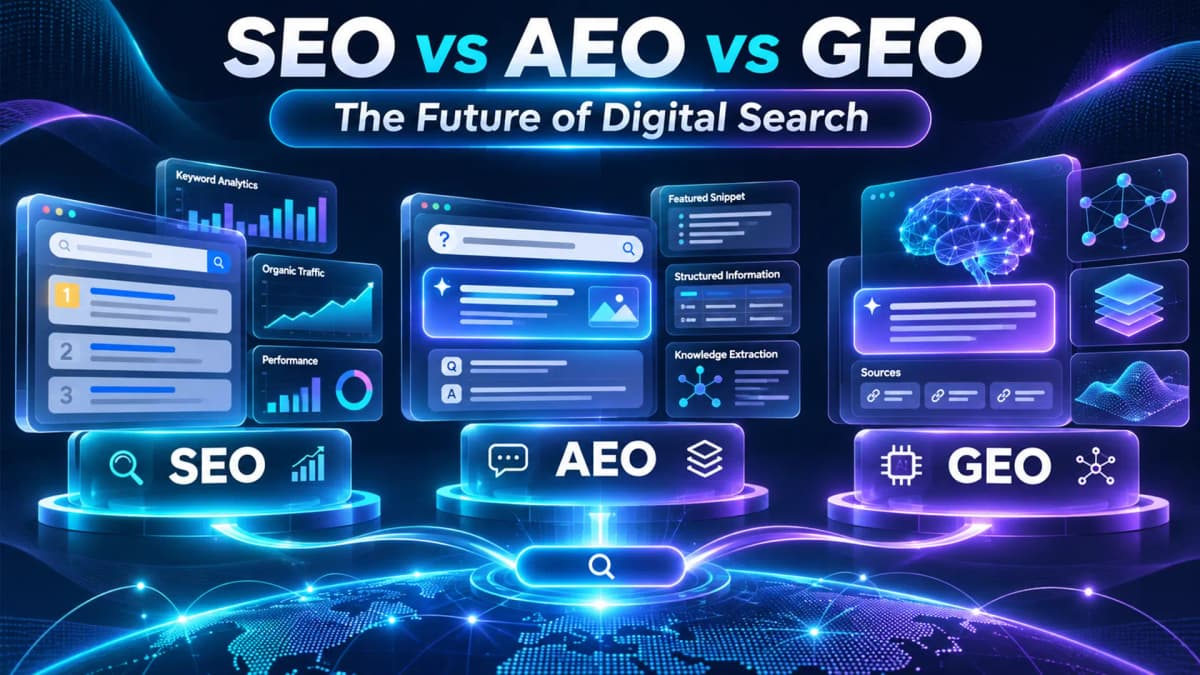
To understand how AEO connects with other search strategies, read our main guide: SEO vs AEO vs GEO: Strategy in the AI Era . It explains the differences between these three approaches.
What Is Answer Engine Optimization (AEO)?
Answer Engine Optimization is an approach to optimizing digital content so answer systems can understand and use website information to respond to user questions.
An answer engine is a system that presents information based on a user's question. Examples include featured snippets, answer boxes, People Also Ask, voice assistants, and AI-generated responses.
AEO focuses on user information needs. Content should provide accurate answers, clear context, simple language, and supporting evidence when necessary.
For example, a user may ask, "What is the difference between a company profile website and a web application?"
A website that follows AEO principles should provide a direct definition near the beginning of the page. The article can then explain the functions, characteristics, differences, and practical examples of both website types.
This structure helps readers find the main answer without reading the entire article. It also gives search systems clearer information about the topic.
AEO Is Not a Special Google Algorithm
It is important to understand that AEO is a digital marketing practice, not an official Google algorithm or ranking program. It also does not have one universal measurement standard across all platforms.
Businesses should not treat AEO as a secret technique that guarantees inclusion in AI answers. It is better understood as a strategy for improving information quality, content structure, and answer relevance.
SEO vs AEO vs GEO: What Is the Difference?
SEO, AEO, and GEO are closely connected. However, each approach emphasizes a different type of search visibility.
| Aspect | SEO | AEO | GEO |
|---|---|---|---|
| Focus | Search visibility. | Direct answers. | References in generative answers. |
| Target | Search engines. | Answer engines. | Generative engines. |
| Content | Relevant to keywords and search intent. | Clear, concise, and direct. | Detailed, contextual, and evidence-based. |
| Example appearance | Organic search results. | Featured snippets and direct answers. | Citations and sources in AI answers. |
| Key metrics | Impressions, clicks, rankings. | Answer coverage, snippet visibility, answer accuracy. | AI citations and brand mentions. |
These differences are conceptual. In practice, AEO and GEO can overlap. An AI-generated answer may provide a direct response and cite a website as its source.
AEO does not replace SEO. Websites still need technical foundations, indexing, clear page structures, and relevant content. AEO expands this approach by making user questions and answer quality central to content planning.
How Does Answer Engine Optimization Work?
Answer-based search systems process questions and identify relevant information. Each platform uses different technologies, but several general processes help explain how AEO works.
1. Understand Search Intent and Question Context
The first step is understanding what the user wants to know. A search system needs to identify whether someone wants a definition, tutorial, comparison, recommendation, or transaction-related information.
For example, "What is ERP?" has an informational intent. However, "What is the best ERP software for a manufacturing company?" involves evaluation and comparison.
These different intents require different answers. Businesses should organize content around real information needs rather than relying only on keyword volume.
2. Find Relevant Information Sources
Search engines use crawling, indexing, and retrieval systems to discover relevant information. AI search systems may also use retrieval-augmented generation, commonly known as RAG.
Google explains that AI Overviews and AI Mode can use information from its Search index to generate answers. These systems may also use query fan-out, which expands one question into several related searches.
This makes website accessibility, content relevance, and information structure important parts of AEO.
3. Evaluate Information Quality and Relevance
Search systems need relevant information to answer user questions. Clear definitions, accurate facts, consistent explanations, and reliable sources help create useful answers.
Content that only repeats common information has limited value. Businesses should include practical experience, data, implementation examples, and explanations that reflect their expertise.
4. Present Answers in the Right Format
Search systems can present information through featured snippets, lists, tables, summaries, voice responses, or AI answers with source links.
These formats help users find information that matches their questions. Website owners should therefore organize content in a logical and readable way.
However, Google independently determines which pages qualify for featured snippets. Website owners cannot use special markup to instruct Google to select a particular page.
Latest AEO and Answer Engine Developments in 2026
OpenAI Introduces Businesses in ChatGPT
In November 2026, OpenAI introduced Businesses in ChatGPT in beta. Through Business Hub, eligible businesses can claim their profiles, verify their organizations, update key information, and add supported product feeds.
Business Hub also provides aggregated insights into business mentions, website clicks, and discovery topics. These insights help companies understand how people discover and engage with their business information.
OpenAI states that it does not share users' private conversations with businesses. Insights are aggregated and available only when interaction thresholds are met.
OpenAI also introduced Business Agents for selected business categories in the United States. These agents allow potential customers to ask follow-up questions about products and services after finding a business profile.
This development matters to AEO because accurate business information plays a growing role in AI-based discovery and customer decisions.
Google Expands Preferred Sources
Google expanded Preferred Sources to AI Overviews and AI Mode in 2026. The feature allows users to select websites they consider preferred information sources.
When a user selects a website, its content may receive a preferred indicator in supported search experiences. Google also provides a button implementation that allows website owners to guide readers through the source selection process.
This creates a new opportunity for publishers to strengthen their relationship with readers. However, website owners need to check domain eligibility through Search Console. Subdirectories such as /blog do not meet the domain-level or subdomain-level requirement for this feature.
Microsoft Introduces AI Performance in Bing Webmaster Tools
On February 10, 2026, Microsoft introduced AI Performance in Bing Webmaster Tools as a public preview. The feature shows how website pages appear as sources in AI-generated answers across Microsoft Copilot, AI-generated summaries in Bing, and supported partner integrations.
Available indicators include total citations, average cited pages, grounding queries, and URL-level citation activity.
Although this tool is more closely related to GEO measurement, its data also supports AEO analysis. Businesses can identify questions that lead to source retrieval and review whether their pages provide relevant answers.
Pew Research Center Studies the Effect of AI Summaries on Clicks
On July 22, 2025, Pew Research Center published a study about how Google users interact with search results that include AI summaries.
The study analyzed browsing activity from 900 U.S. adults during March 2025. Its dataset included 68,879 Google searches, including 12,593 searches that displayed an AI summary.
Users clicked traditional search results in 8% of visits when an AI summary appeared. The rate reached 15% when no AI summary appeared. Users clicked links within AI summaries in only about 1% of visits involving an AI summary.
These findings show that content visibility in an answer does not always generate website visits. Businesses should measure answer visibility, referral traffic, and conversions separately.
The findings reflect U.S. users and a specific research period. Businesses should not assume that the same rates apply to every country, industry, or platform.
AEO Strategy: How to Optimize Content for AI
AEO requires a user-focused approach. Businesses need to identify relevant questions, prepare useful answers, provide context, and ensure that their information is accurate.
1. Research Questions That People Actually Ask
Start by collecting questions from potential customers. Do not rely only on keywords with high search volume.
Use several information sources:
- Google Search Console to identify queries that generate impressions.
- Google Keyword Planner to explore keyword variations and search demand.
- People Also Ask to discover related questions.
- Google Trends to understand changes in search interest.
- Forums, communities, and social media to identify customer problems.
- Sales and customer support teams to collect real questions.
- Internal website search data, when available.
For example, a software development company may discover questions such as "How much does business application development cost?", "What is the difference between web and mobile applications?", and "How do I choose a software development company?"
Group these questions by topic, user needs, and buying stage. This helps content teams avoid publishing articles that target keywords without providing useful information.
2. Provide a Direct Answer Near the Beginning
Users want to understand the main answer quickly. Place the primary explanation immediately after the relevant heading.
For example, an article titled "What Is CRM?" should define CRM in its opening paragraph. The article can then explain its functions, benefits, types, use cases, and software selection criteria.
Do not hide the answer near the end of the article. An unnecessarily long introduction can make it harder for readers to find the information they need.
There is no universal word count that guarantees selection as an answer. Prioritize accuracy, completeness, and clarity.
3. Use Question-Based Headings
Question-based headings help readers understand what each section covers. They also create a clear relationship between a question and its answer.
Examples include:
- What Is Answer Engine Optimization?
- How Does AEO Work?
- What Is the Difference Between AEO and SEO?
- How Can You Optimize Content for AI Search?
- How Do You Measure AEO Performance?
Use headings that match actual user needs. Avoid adding irrelevant questions simply to increase keyword variations.
4. Create a Clear and Readable Content Structure
A clear structure helps readers understand how different pieces of information connect. Use H1 for the main topic, H2 for major sections, and H3 for more specific explanations.
Use lists for processes, tables for comparisons, and examples when a concept needs practical explanation.
Avoid overly long paragraphs and repeated definitions. Each section should serve a clear purpose.
5. Support Information with Data and Reliable Sources
Useful answers need reliable information. When an article includes statistical claims, provide sources that readers can verify.
Prioritize official documentation, industry reports, academic publications, company data, and genuine case studies.
For example, an article about application security can reference OWASP documentation. An article about website performance can refer to Google's Core Web Vitals documentation.
Avoid statistics without sources and testimonials that readers cannot verify. Inaccurate information can damage customer trust.
6. Demonstrate Author Experience and Expertise
Business content should explain why readers can trust its information. Include the author's identity, relevant experience, professional expertise, and technical reviewer when appropriate.
Technology companies can strengthen their content with project documentation, implementation processes, case studies, and examples of problems they have solved for clients.
Do not create author profiles or expertise claims that do not reflect actual experience.
7. Optimize Local Business Information
Businesses that serve local markets should make their location information easy to find and consistent.
Review the business name, address, phone number, opening hours, service areas, and business categories. Keep Google Business Profile and Bing Places information accurate.
For example, a company offering website development services in Medan can create a service page that explains its service area, project types, consultation process, portfolio, and contact information.
Avoid creating location pages that only replace city names without adding useful local information.
8. Use Structured Data Correctly
Structured data helps search engines understand the types of information on a page. Businesses can use relevant markup such as Organization, Article, Product, BreadcrumbList, and LocalBusiness when the content meets the requirements.
Use JSON-LD when it fits the website's technical needs. Ensure that every property accurately describes information visible to visitors.
Structured data does not guarantee featured snippets or AI answers. Google also explains that websites do not need special schema.org markup to appear in AI Overviews or AI Mode.
One important update deserves attention. Google stopped displaying FAQ rich results on May 7, 2026. FAQ content remains useful for customers, but businesses should not add FAQPage markup solely to obtain Google's FAQ rich result.
9. Make Sure Search Systems Can Access Your Website
Valuable content cannot reach its full potential when important pages have crawling or indexing problems.
- Use HTTPS and appropriate security settings.
- Check robots.txt and page indexing status.
- Make important content available as processable text.
- Maintain an updated XML sitemap.
- Fix broken links and canonical issues.
- Make the website responsive on mobile devices.
- Use relevant internal links.
- Check JavaScript rendering on important pages.
If a business wants its content to appear in ChatGPT Search, it should also review access for OAI-SearchBot. OpenAI distinguishes OAI-SearchBot, which supports discovery in ChatGPT search, from GPTBot, which supports model training. Website owners can manage these bots separately through robots.txt.
How to Measure Answer Engine Optimization Performance
Businesses need measurement to understand whether their content helps users. The number of published articles alone cannot show whether an AEO strategy works.
Use a systematic process: collect data, clean information, define metrics, analyze patterns, and take action.
Stage 1: Collect Data
Collect information from several sources based on the measurement objectives.
- Google Search Console: review impressions, clicks, CTR, queries, and pages.
- Google Analytics 4: measure sessions, engagement, referrals, and conversions.
- Bing Webmaster Tools: review citation activity through AI Performance.
- AI platform testing: check whether content answers questions in ChatGPT, Gemini, and Perplexity.
- CRM: connect lead sources with consultation requests and sales.
- Customer support: collect questions that customers frequently ask.
Stage 2: Clean and Organize Information
Standardize collected data before analysis. Remove duplicate URLs, use consistent date formats, group queries, and separate records by traffic source.
Also separate answer appearances, citations, clicks, and conversions. A page may appear as an AI source without generating a website visit.
Stage 3: Define AEO Metrics
| Metric | Definition | Purpose |
|---|---|---|
| Answer Coverage | Share of target questions with relevant answer content. | Measure information coverage. |
| Featured Snippet Visibility | Page appearances in featured snippets across a query sample. | Measure direct-answer visibility. |
| Answer Accuracy | Accuracy of the information presented by answer systems. | Monitor brand information quality. |
| Question Coverage | Number of relevant questions addressed by website content. | Identify content gaps. |
| Answer Referral Traffic | Visits from answer-based search platforms. | Measure generated visits. |
| Conversion Rate | Percentage of visitors who complete an important action. | Measure business contribution. |
These AEO metrics form an operational measurement framework. They are not an official standard shared by every platform. Businesses should define each metric and its collection method before comparing results.
Stage 4: Analyze Data Patterns
Compare performance across periods, question groups, pages, and platforms.
For example, an article may receive many impressions for informational queries but generate few clicks. The team should examine whether the title matches user intent, whether the search result displays a direct answer, and whether users still need additional information.
If content frequently appears in AI answers but generates little referral traffic, review the accuracy of the displayed information and whether the landing page provides a useful reason for visitors to continue.
Stage 5: Take Action
Use the analysis to set priorities. Improve pages that do not answer questions completely. Add evidence to important claims. Update information that is no longer relevant.
If the business discovers new questions that customers frequently ask, create supporting content to address those needs. Connect each article to relevant service pages through contextual internal links.
Practical AEO Implementation for a Technology Business
Consider a software development company that wants its website to become a useful source when potential customers search for business application development information.
The team starts by collecting questions from potential customers and sales staff. They identify several key needs, including development costs, project stages, technology selection, application security, and system maintenance.
| User Question | Content Type | Main Answer |
|---|---|---|
| How much does application development cost? | Cost guide. | Factors that affect project costs and scope. |
| How does application development work? | Process guide. | Analysis, design, development, testing, and maintenance. |
| What is custom software? | Educational article. | Definition and differences from ready-made software. |
| How do I choose a software development company? | Vendor evaluation guide. | Experience, portfolio, security, and workflow. |
Each page provides a direct answer near the beginning and expands the topic with practical examples and supporting information. The company also adds links to its portfolio and service pages.
The team then tests the same questions across several platforms. It records whether AI answers match the company's information, whether the website becomes a source, and whether users visit the website.
This approach turns AEO into an optimization process that the business can evaluate. The team does more than publish articles. It also checks answer quality and its contribution to business needs.
Common AEO Mistakes Businesses Should Avoid
Assuming Featured Snippets Are Guaranteed
Google independently selects pages for featured snippets. Good content structure can improve understanding, but it does not guarantee a featured snippet.
Creating FAQs Only to Obtain Rich Results
FAQs remain useful for answering customer questions. However, Google stopped showing FAQ rich results on May 7, 2026. Create FAQ content for its information value rather than relying on a special Google appearance.
Repeating Keywords Too Often
Excessive keyword repetition can damage readability. Use the main term naturally and explain related concepts based on user needs.
Providing Short Answers Without Context
Short answers help readers find the main point. However, some questions require explanation, evidence, and limitations. Do not remove important context just to make an answer shorter.
Using Incorrect Structured Data
Markup should accurately reflect visible content. Do not add hidden data, false information, or schema that does not match the page.
Ignoring AI Answer Accuracy
AI systems may present incomplete information or misunderstand context. Businesses should test answers regularly and correct inconsistent official information.
A 90-Day AEO Implementation Roadmap
Businesses can start AEO through three stages. This roadmap provides an initial plan. Actual results depend on website conditions, competition, content quality, and platform changes.
| Period | Focus | Activities | Output |
|---|---|---|---|
| Days 1-30 | Audit and question research | Website audit, query research, intent analysis, and measurement baseline. | Information needs map. |
| Days 31-60 | Content optimization | Improve content structure, direct answers, sources, internal links, and business information. | More useful website pages. |
| Days 61-90 | Measurement and evaluation | Test answer visibility, review referrals, analyze conversions, and update content. | Performance report and next priorities. |
After 90 days, teams should compare the results with their initial baseline. The review should consider answer visibility, information quality, visitor behavior, and lead generation.
Why Does AEO Matter for Business Digital Strategies?
AEO helps businesses address customer information needs at different stages of the buying journey. Potential customers may search for definitions, compare services, evaluate vendors, and review company information before contacting a provider.
Content that provides clear answers can help businesses build understanding and trust. However, answer visibility does not always generate clicks. Pew Research Center findings show that users often receive information from AI summaries without visiting source websites.
Businesses should therefore provide valuable information for each decision stage. Educational articles should answer reader questions. Service pages should explain benefits, processes, scope, and contact options.
AEO works best when businesses integrate it with SEO, GEO, website development, and digital analytics. This combination helps companies understand both search visibility and business outcomes.
Frequently Asked Questions About Answer Engine Optimization
What is Answer Engine Optimization (AEO)?
AEO is an approach to optimizing content so search engines, featured snippets, voice assistants, and AI platforms can understand website information and use it to answer user questions.
What is the difference between AEO and SEO?
SEO focuses on organic search visibility. AEO focuses on providing direct answers to user questions. Both approaches support one another.
How can I optimize content for AI?
Research user questions, provide direct answers, use relevant headings, include reliable data and sources, demonstrate author expertise, and make sure search systems can access your website.
Can AEO guarantee a featured snippet?
No. Google selects featured snippet pages through its search systems. Website owners cannot instruct Google to select a particular page.
Is FAQ schema still necessary for AEO?
FAQ content remains useful for answering user questions. However, Google stopped displaying FAQ rich results on May 7, 2026. Businesses should not use FAQ schema only to obtain that appearance.
Is AEO the same as GEO?
Not exactly. AEO emphasizes direct answers to user questions. GEO focuses on the opportunity for content to become a source in generative answers. Both approaches have overlapping areas.
How can businesses measure AEO performance?
Businesses can measure answer coverage, featured snippet visibility, answer accuracy, referral visits, engagement, and conversions. Each indicator needs a consistent definition and measurement method.
Do small businesses need AEO?
Yes. Small businesses can start by answering customer questions, improving service pages, updating local business information, and improving website structure.
How long does AEO take to show results?
There is no fixed timeline. Results depend on website conditions, content quality, competition, source reputation, and the search systems involved.
Improve Your Business Website and Content with PT Code Hero Indonesia
Changes in search behavior require businesses to improve content quality and website foundations. Clear information, accurate answers, and a strong technical structure help companies build a more effective digital presence.
PT Code Hero Indonesia helps businesses develop websites, improve digital structures, and implement professional SEO strategies that support modern search requirements.
Explore Professional SEO Services