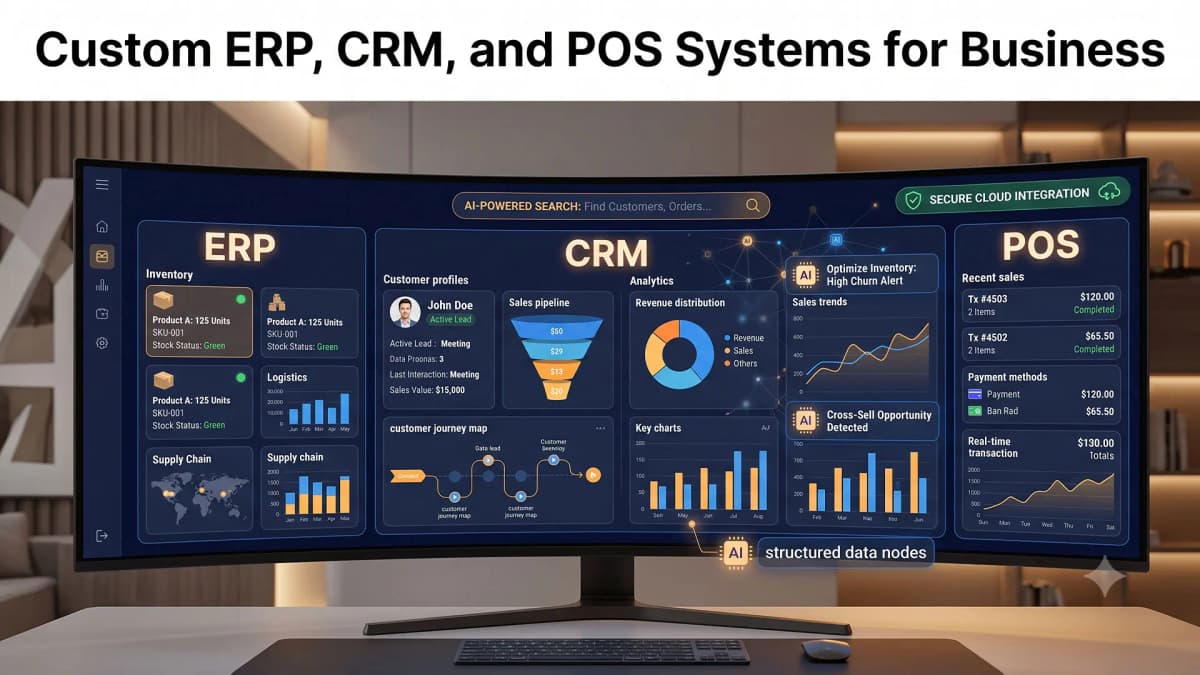
As a company grows, its operations naturally become more complex. More employees, transactions, customers, products, warehouses, and business units generate more data and require tighter coordination. Processes that once worked with spreadsheets and independent applications may eventually become bottlenecks.
Sales data may be stored in one system, inventory in another, purchasing in spreadsheets, and financial reports prepared through manual reconciliation. Employees spend valuable time entering the same information repeatedly, while managers may receive important reports only after the data has already become outdated.
A custom ERP system addresses this challenge by connecting core business functions through an integrated digital platform designed around the company's actual workflows.
Instead of forcing an organization to adapt to rigid software templates, custom ERP can align modules, permissions, approval processes, integrations, reports, and dashboards with real operational requirements.
What Is a Custom ERP System?
ERP stands for Enterprise Resource Planning . It is a system designed to connect and manage essential business processes such as sales, inventory, purchasing, finance, manufacturing, human resources, customer management, and reporting.
A custom ERP takes this concept further by building the system specifically around an individual company's workflows and objectives.
For example, when a sales order is confirmed, a properly integrated ERP may automatically update inventory availability, create relevant financial records, notify the warehouse, trigger approval when necessary, and update management dashboards.
This eliminates much of the repetitive data movement that normally occurs when departments operate through disconnected applications.
Custom ERP can also be modular. A company may start with inventory and purchasing, then introduce finance, HR, manufacturing, CRM, asset management, or business intelligence as operational requirements evolve.
Custom ERP vs Off-the-Shelf ERP
Off-the-shelf ERP can be an effective solution for companies with relatively standardized processes. It offers established features and often enables faster initial deployment.
However, a growing organization may eventually need to determine whether its business should continue adapting to software limitations or whether the software should adapt to its business.
| Area | Custom ERP | Off-the-Shelf ERP |
|---|---|---|
| Workflow | Designed around company processes | Based on predefined workflows |
| Features | Prioritized according to business requirements | Determined by vendor roadmap |
| Integration | Supports specialized APIs and internal systems | Limited by supported integrations |
| Scalability | Evolves with business growth | Depends on vendor capabilities |
| Reporting | Built around company KPIs | Uses available templates |
The right choice depends on workflow complexity, integration requirements, total cost, growth strategy, data ownership, and the expected business value of customization.
7 Major Benefits of Custom ERP for Companies
1. Centralized Business Data
One of the biggest operational challenges in growing companies is fragmented data. Sales teams may have customer and order information, warehouse teams maintain stock records, purchasing manages suppliers, and finance performs separate reconciliation.
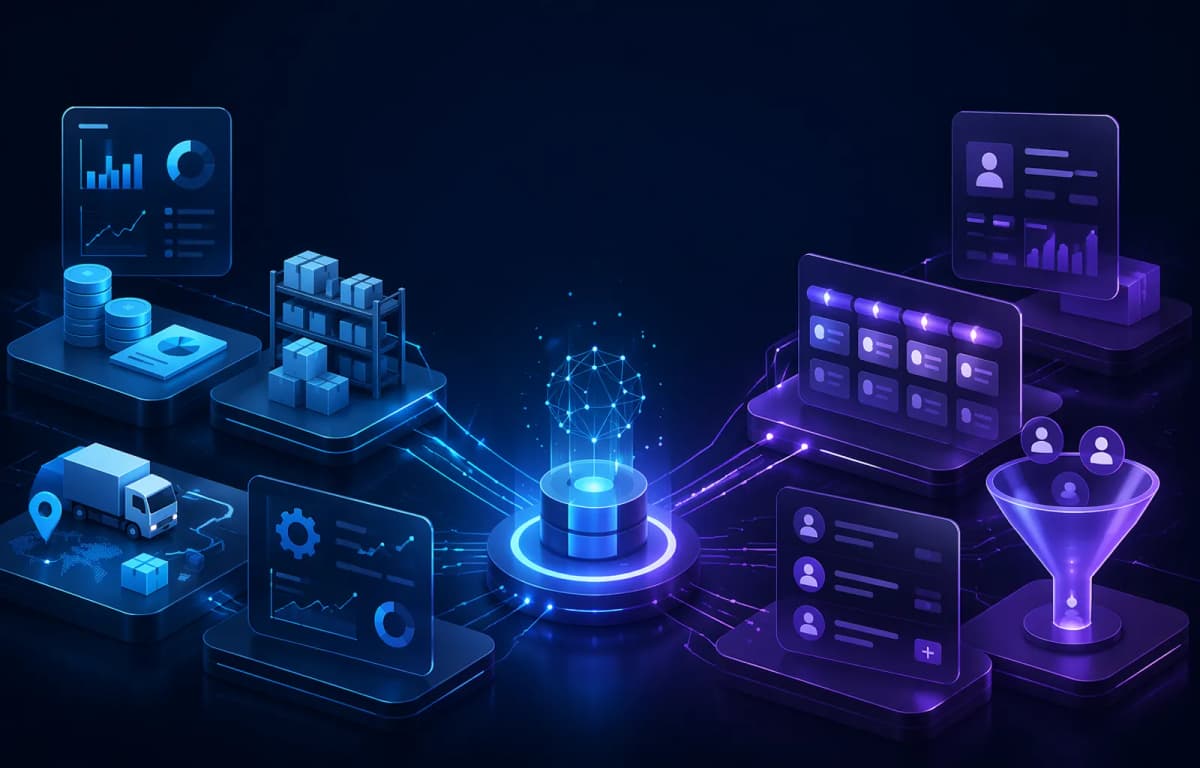
Custom ERP connects these activities through a centralized database, creating a reliable single source of truth where teams work with consistent information.
2. Workflow Automation
Repetitive administrative work consumes employee time and increases the risk of human error. ERP can automate purchase orders, stock updates, invoice creation, approval routing, notifications, payment reminders, and reporting.
3. Higher Employee Productivity
Productivity improves when unnecessary friction is removed from daily operations. A well-designed custom ERP gives users access to the information and functions relevant to their roles.
4. Faster Management Visibility
ERP dashboards bring together sales, inventory, purchasing, receivables, operational activities, manufacturing metrics, and other KPIs into a clearer and faster reporting environment.
5. Better Process Control and Standardization
Custom ERP transforms business rules into digital workflows, including approval limits, user permissions, purchasing procedures, transaction validation, and activity tracking.
6. Scalability for Business Growth
A scalable ERP architecture allows companies to expand users, branches, integrations, transaction volumes, and additional modules without rebuilding the system.
7. Reduced Cost of Operational Inefficiency
ERP reduces hidden costs caused by repetitive work, reporting delays, incorrect data, stock discrepancies, inefficient approvals, and duplicated administration.
Common Custom ERP Modules
The ideal ERP architecture differs between companies. Common modules include:
- Sales Management: quotations, orders, invoices, targets, reporting.
- Inventory & Warehouse: stock levels, transfers, warehouses, replenishment.
- Purchasing: purchase requests, suppliers, receiving, approvals.
- Finance & Accounting: payments, receivables, cash flow, reporting.
- HRIS & Payroll: employees, attendance, payroll, self-service.
- Business Intelligence: dashboards and KPI analytics.
Ready to Improve Business Efficiency with a Custom ERP?
A valuable ERP system does more than digitize existing forms. It reduces manual work, connects business data, improves process control, increases visibility, and helps teams make better decisions.
Discuss Your Custom ERP Requirements