Operational digitalization is not simply the conversion of paper forms into online forms. It requires companies to improve workflows, connect fragmented data, automate repetitive activities, and create systems that can scale with the business. A capable software house supports this process from strategy to implementation.
Key takeaways
- 1.Successful digitalization starts with an operational problem, not a preferred technology.
- 2.Custom software is most valuable when workflows, integrations, controls, or reporting requirements are specific to the company.
- 3.Long-term results depend on process ownership, data quality, user adoption, security, documentation, and post-launch support.
Why companies digitalize business operations
Business growth increases operational complexity. Transaction volumes rise, teams expand, new branches open, and customers expect faster service. Yet many organizations still depend on disconnected spreadsheets, private messages, manual approvals, and reports that must be rebuilt every week or month.
These methods may work at a small scale. They become fragile as the organization grows. Employees copy the same information into multiple files. Managers cannot see the current status of work. Data definitions differ between departments. Errors remain hidden until they affect customers, inventory, billing, or compliance.
Operational digitalization creates a more reliable flow of information. A well-designed system captures data from defined sources, applies business rules, records activity, routes approvals, sends notifications, and presents relevant information to each user. The goal is not technology for its own sake. The goal is stronger control over service quality, speed, cost, risk, and decision-making.
What does a software house do?
A software house is a technology partner that designs, develops, tests, deploys, and maintains software products. Its services may include web applications, mobile apps, internal systems, ERP platforms, POS solutions, CRM tools, management dashboards, customer portals, API integration, and legacy software modernization.
In an operational digitalization project, the work should extend beyond coding. The delivery team must understand business processes, identify bottlenecks, define priorities, design the system architecture, create usable interfaces, plan data migration, test critical scenarios, and support adoption.
This broader role matters because feature-rich software can still fail in practice. Users may reject a system when tasks require too many steps, terminology is unclear, exceptions are ignored, reports do not support decisions, or the software does not reflect actual operational rules.
Signs that operations need digitalization
Business data is fragmented
Customer, inventory, sales, project, and payment data lives in separate files or applications. Teams spend hours searching, reconciling, and re-entering information.
Approvals take too long
Purchase requests, expenses, discounts, leave requests, and data changes move through long message threads with limited visibility and weak audit trails.
Management reports arrive late
Leaders wait for manual consolidation before they can assess sales, stock, productivity, delivery status, or operational risk.
The same errors keep returning
Duplicate records, inconsistent document numbers, missing updates, and mismatched customer data become normal operating problems.
Legacy systems block change
Applications have limited documentation, depend on one person, cannot support new integrations, or are difficult to update safely.
Growth creates proportional administrative work
Every new branch, product, employee, or customer adds another layer of manual coordination instead of benefiting from reusable processes.
Operational systems a software house can build
1. Custom ERP systems
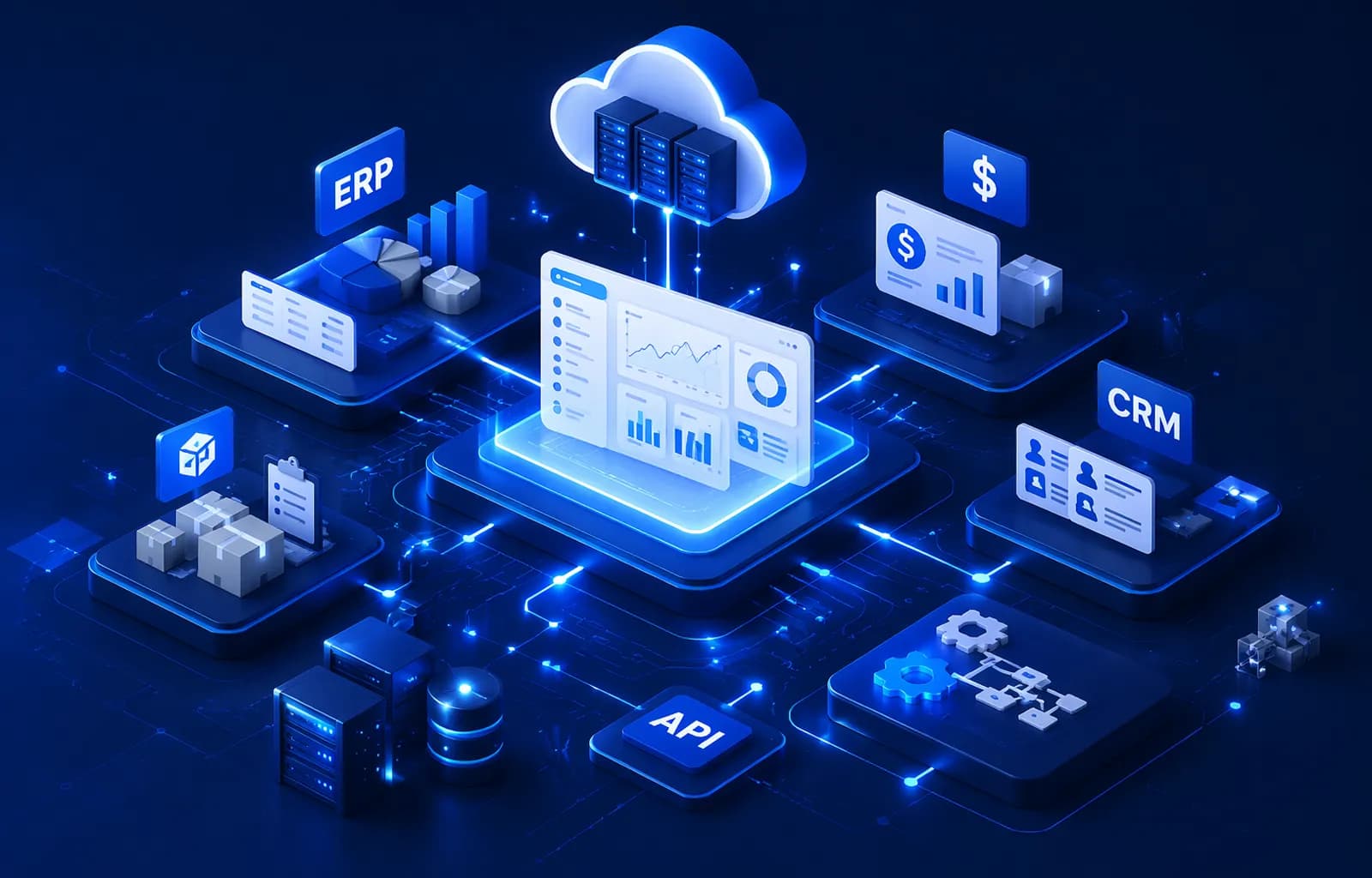
An ERP connects functions such as sales, procurement, inventory, finance, production, and human resources. Custom ERP development is useful when a company has specialized workflows, multi-level approvals, complex product structures, or reporting needs that standard products cannot address efficiently.
2. POS and multi-location management
A POS platform can manage transactions, products, promotions, stock, cashier activity, and branch reporting. Integration with inventory and central management systems gives the company a more consistent view of sales and product availability.
3. CRM and customer portals
A CRM organizes leads, communication history, quotations, tasks, and follow-ups. A customer portal can add ordering, service tracking, document access, support requests, account information, and payment functions.
4. Field operation applications
Sales representatives, technicians, surveyors, couriers, and inspectors need mobile-friendly tools. Features may include location capture, photos, digital signatures, inspection forms, schedules, offline work, and data synchronization.
5. Management dashboards and analytics
Dashboards turn operational data into useful indicators. Leaders can monitor targets, turnaround time, capacity, productivity, sales, cost, service levels, and exceptions that require action.
6. API and system integration
A company does not always need to replace every application. A software development partner can connect internal systems with payment gateways, accounting platforms, logistics providers, marketplaces, communication services, or industry-specific tools. Integration reduces duplicate work and supports data consistency.
7. Legacy application modernization
Older software can be improved in stages. Teams may separate modules, redesign interfaces, move infrastructure, add APIs, strengthen security, and replace difficult components while maintaining business continuity.
Custom software or off-the-shelf software?
Custom development is not automatically the best option. Off-the-shelf software is suitable for common requirements, standardized processes, limited initial budgets, and very short implementation timelines. Business email, basic collaboration, and simple accounting are common examples.
Custom software becomes more relevant when the process creates competitive value, integrations are complex, user volumes are high, data control is critical, or long-term flexibility matters. A hybrid approach is often practical. The company uses standard tools for common functions and builds custom modules for core operations.
| Factor | Off-the-shelf | Custom software |
|---|---|---|
| Initial speed | Usually faster | Requires design and development |
| Process fit | Business adapts to the product | Software adapts to the business |
| Integration | Limited to available connectors | Can be designed for specific systems |
| Scalability | Depends on vendor plans | Can be planned around growth |
A practical digitalization roadmap
-
1. Discovery and process mapping
The team studies business goals, users, documents, approval rules, data sources, bottlenecks, exceptions, and existing systems. Actual daily work should be observed instead of relying only on written procedures.
-
2. Prioritization and scope definition
The company and software house define the most important problem, expected outcomes, initial modules, project boundaries, risks, assumptions, and success metrics. This step prevents uncontrolled expansion.
-
3. Solution architecture and UI/UX design
The team creates the architecture, data flows, permission model, wireframes, prototypes, and interface design. Key users should validate the proposed workflow before full development begins.
-
4. Iterative development
Features are delivered in manageable iterations. Stakeholders can review working components early and correct assumptions before changes become expensive.
-
5. Testing and data migration
Testing covers functionality, integrations, permissions, performance, critical security controls, and real user scenarios. Historical data must be cleaned, mapped, tested, and validated before migration.
-
6. Launch and user enablement
The rollout may be organized by module, department, branch, or user group. Training, guides, support channels, and internal champions help employees adjust to the new process.
-
7. Maintenance and continuous improvement
The system must be monitored, updated, backed up, and refined. Usage data, incidents, and user feedback guide the next development priorities.
Technical foundations that matter
Scalable and maintainable architecture
Architecture should match expected users, transaction frequency, data volume, integrations, availability requirements, and maintenance capabilities. A structured codebase makes future modules and changes easier to manage.
Risk-based security
Security should be built into the project. Important elements include authentication, role-based access, relevant encryption, activity logs, dependency updates, backups, recovery procedures, and controlled administrative access.
Data governance
The company should define authoritative sources, formats, owners, change rules, retention periods, and access rights. Even an excellent application cannot produce reliable insights from inconsistent data.
Documented integrations
Each integration needs clear data contracts, error handling, logs, usage limits, ownership, and documentation. The company should also understand dependencies on external vendors.
Monitoring and support
Operational systems need logs, health monitoring, alerts, incident procedures, and escalation paths. Teams should be able to detect and investigate problems before they affect many users.
How to select a software house
Price matters, but it should not be the only selection criterion. Companies need a partner that can understand operations and manage delivery risk.
- Discovery capability. The team should ask about goals, users, data, rules, exceptions, dependencies, and organizational change.
- Relevant delivery experience. Review the complexity of past work, not only visual design. Look for experience with internal systems, integrations, transactions, or multi-location operations.
- A clear delivery method. Confirm milestones, scope controls, change requests, testing, responsibilities, and acceptance criteria.
- Transparent communication. Stakeholders should receive regular information about progress, risks, decisions, and blockers.
- Sound engineering practices. Ask about code management, documentation, environments, backups, security, deployment, testing, and monitoring.
- Post-launch support. Define warranty periods, service levels, support hours, incident handling, and the model for future improvements.
- Clear ownership terms. Contracts should explain ownership of code, data, cloud accounts, documentation, designs, and administrative credentials.
Budgeting and scope planning
A realistic budget includes more than initial development. Companies should account for discovery, design, integration, data migration, infrastructure, third-party services, training, maintenance, and future enhancements. This broader view allows management to compare investment with the cost and risk of current manual work.
Scope should follow business priority. Separate essential capabilities from efficiency improvements and optional features. A focused first release can create value while giving the organization real usage data for later decisions.
Avoid estimating complexity by counting screens alone. Business rules, roles, integrations, data volume, exception paths, security, reporting, and availability requirements often determine the true effort. A strong scope document defines outcomes, boundaries, assumptions, dependencies, and acceptance conditions.
Internal governance for a successful project
The company should appoint a process owner with authority to make decisions. That person works with user representatives, internal IT, management, and the software house. A defined structure reduces delays when departments have different priorities.
Important decisions should be recorded. This includes workflow changes, data definitions, access rules, priorities, and test results. Decision logs prevent repeated debates and help new team members understand why the system works in a particular way.
Management must also explain the reason for change. Employees are more likely to adopt a new system when they understand the problem, the effect on their work, and the support available. Digitalization is an operating model change supported by technology.
How to measure operational digitalization
A completed application is not the final measure of success. Track changes in operational performance and user behavior.
Cycle time
Time from request to completion.
Error rate
Corrections, duplicates, and failed transactions.
User adoption
Active users, task completion, and usage frequency.
Data quality
Completeness, consistency, and accuracy.
Operating cost
Administrative effort and rework cost.
User satisfaction
Feedback from employees, partners, or customers.
Common digitalization mistakes
Starting with a feature list
A long feature list without a clear problem statement can produce expensive software that does not remove the main bottleneck.
Automating a poor process without redesign
An unnecessarily complex workflow remains inefficient after it is moved into an application.
Excluding end users
Users should validate terminology, workflows, interfaces, exceptions, and testing scenarios.
Underestimating data migration
Historical data often contains duplicates and conflicting formats. Cleaning and validation must be part of the project plan.
Treating launch as the finish line
After deployment, the company must still monitor incidents, adoption, security, performance, and new operational needs.
PT Code Hero Indonesia as a digitalization partner
PT Code Hero Indonesia supports companies with professional websites, web and mobile applications, custom software, ERP and POS systems, UI/UX design, integrations, IT consulting, maintenance, and technical support.
An operational project can begin with requirement mapping and priority definition. The team can then design the architecture and interface, develop and test the solution, support deployment, and continue with maintenance or optimization. An iterative method helps companies control scope and validate decisions earlier.
This approach can support organizations building a new system, connecting existing applications, modernizing a legacy platform, or starting with one high-impact process before expanding to a wider digital ecosystem.
Questions to prepare before a consultation
- Which process causes the most delays, errors, or rework?
- Who will use the system and what decisions does each role make?
- What data is required, where does it come from, and who owns it?
- Which current applications must remain or be integrated?
- How many users, locations, transactions, and future growth should the system support?
- Which reports or alerts are necessary for management?
- Which risks must be controlled, including access, downtime, and data loss?
- What measurable results should be achieved within three, six, or twelve months?
Software house services FAQ
How long does operational software development take?
The timeline depends on scope, integrations, data quality, user volume, and complexity. Phased delivery allows priority modules to be tested earlier.
Does a company need to replace every legacy system?
Not always. Existing systems can be integrated, modernized by module, or replaced in stages according to business value and operational risk.
Is custom software suitable for small and medium businesses?
Yes, when a core process cannot be handled efficiently by general software. A smaller company can begin with a focused module and measurable goals.
What should the company receive after delivery?
The organization should have system access, documentation, user guidance, configuration records, backup procedures, integration details, and a defined support process.
How can software remain relevant over time?
Review usage data, process changes, user feedback, security risks, performance, and new business goals on a regular basis.
Start with one important operational problem
Effective digitalization does not need to begin with a large platform. A company can start with one process that is slow, error-prone, or difficult to monitor. An initial assessment can determine whether the best solution is custom software, integration, a management dashboard, legacy modernization, or a combination of approaches.
Explore PT Code Hero Indonesia Services