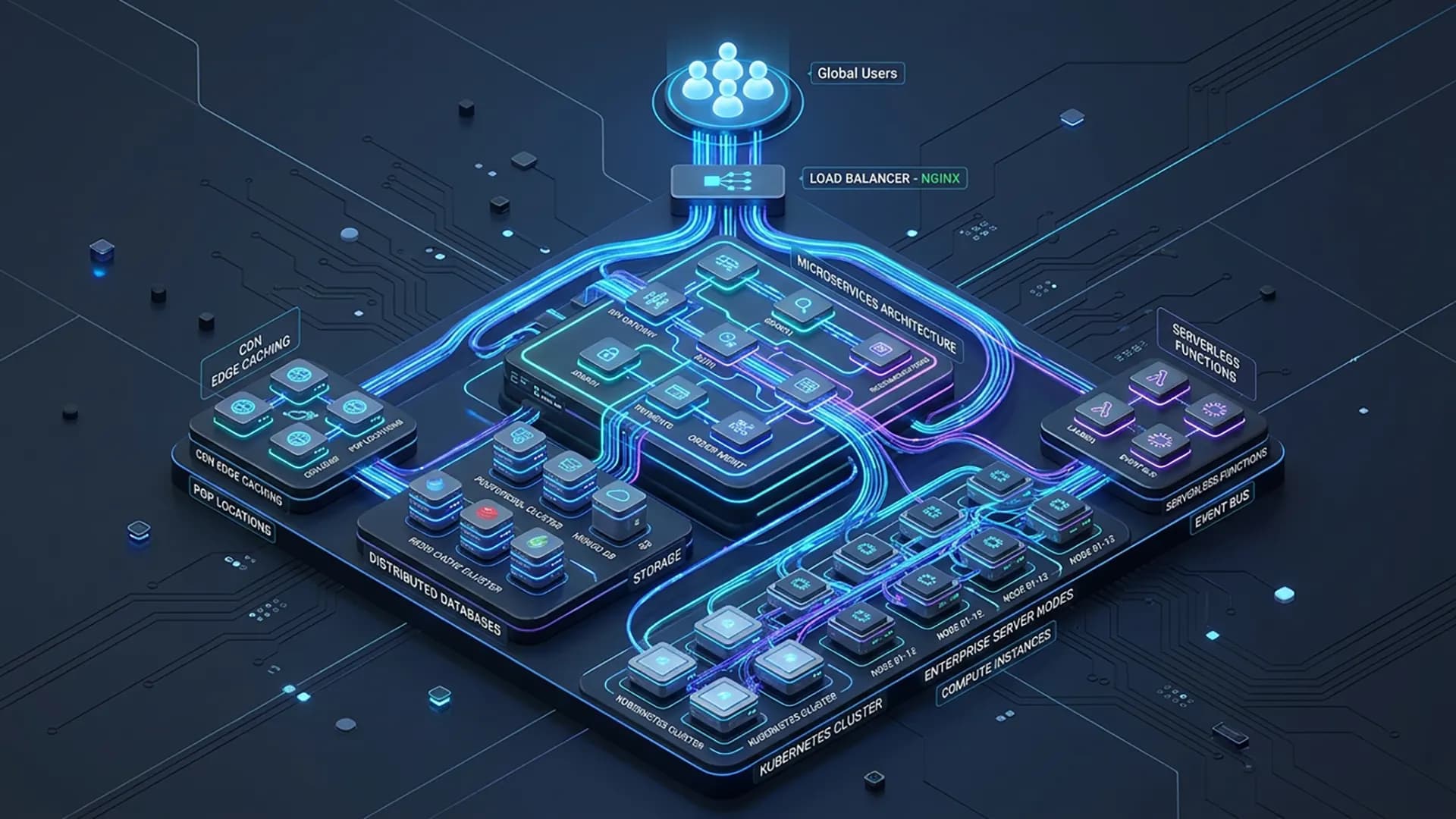
Executive Summary for CTOs & Technology Leaders
• Hardware Is Rarely the Primary Bottleneck: Sudden traffic spikes (flash promotions, viral product launches) crash websites due to exhausted database connection pools and un-cached synchronous compute cycles, rather than sheer network pipe capacity.
• Multi-Tiered Caching Defenses: Combining Edge CDN Caching (Cloudflare/CloudFront), HTTP micro-caching, and in-memory key-value stores (Redis) absorbs up to 90% of requests before they ever reach your origin application servers.
• Asynchronous Offloading & Clean Decoupling: Shifting compute-heavy workloads to background message queues and separating frontend rendering from backend APIs via specialized website development services provides the foundation for resilient 99.99% operational uptime.
For high-growth businesses and enterprise brands, the moment a marketing campaign attracts tens of thousands of active buyers within minutes should be celebrated as a victory. Yet, without a rigorously engineered modern web architecture, this golden milestone can quickly turn into a costly public relations crisis as servers choke and present visitors with dreaded HTTP 502 Bad Gateway or 504 Gateway Timeout screens.
True web resilience under intense traffic surges is not a matter of simply provisioning larger virtual machines with more CPU cores. A monolithic application built with inefficient database queries and blocking synchronous execution will inevitably crumble when thousands of concurrent users attempt to check out simultaneously. This article breaks down the architectural blueprint required to engineer ultra-fast, fault-tolerant, and elastic web platforms.
Why Traditional Web Architectures Fail Under High-Traffic Surges
To build bulletproof systems, engineering leaders must recognize the cascading failure chain characteristic of single-server or monolithic setups. When thousands of requests hit an application simultaneously, three critical bottlenecks emerge:
Database Connection Starvation
When each incoming request spawns an un-pooled SQL connection, database threads saturate instantly. Queries queue indefinitely, table locks proliferate, and the central database ceases to respond.
Dynamic SSR Overhead
Re-rendering complete HTML pages from scratch on every single HTTP request burns origin CPU cycles rapidly. Web servers deplete their worker pool and discard incoming connections.
Blocking Synchronous Tasks
Executing PDF invoice compilation, transactional emails, or external CRM API calls inside the main HTTP lifecycle blocks user browser threads and paralyzes response throughput.
Consequently, advanced web scalability is no longer about "how much hardware can we buy" (vertical scaling), but rather "how many requests can we satisfy before they ever reach our origin database" (edge caching and distributed decoupling).
The 4 Core Pillars of a High-Performance Modern Web Architecture
Enterprise architectures designed by seasoned software teams employ four interlocking layers of defense to deliver sustained sub-second response times under extreme concurrency:
Multi-Tier Edge Caching & Global CDNs
Next-generation Content Delivery Networks (CDNs) like Cloudflare, AWS CloudFront, and Fastly do far more than distribute static media. Leveraging Edge Workers and smart cache invalidation headers (stale-while-revalidate), edge networks serve full HTML responses directly from hundreds of globally distributed Points of Presence (PoPs) nearest to the end user.
Hybrid Rendering: SSG, ISR, and Streaming SSR
Modern JavaScript frameworks like Next.js enable Incremental Static Regeneration (ISR). With ISR, product catalog pages and articles are compiled into pre-rendered static HTML during deployment, yet can automatically revalidate in the background when content changes occur—completely eliminating origin server bottlenecks.
For authenticated user portals, React Server Components (RSC) and Streaming SSR deliver instant visual page shells while heavy dynamic data modules stream down progressively without blocking the initial paint.
In-Memory Database Caching (Redis / Memcached)
Reading data from in-memory stores like Redis takes less than 1 millisecond, compared to 50–200 milliseconds for disk-based relational queries in PostgreSQL or MySQL. Adopting the Cache-Aside Pattern ensures system configs, user session tokens, top-tier inventory records, and shopping carts reside in high-speed RAM.
Asynchronous Job Queues (Message-Driven Architecture)
In modern commercial environments such as high-volume e-commerce website development or enterprise portals, checkout requests only need to validate input and save initial status. Generating receipt PDFs, verifying payment webhooks, and pushing CRM sync records are offloaded to background worker queues, ensuring immediate, friction-free customer experiences.
Architecture Comparison: Monolithic Server vs Distributed Modern Architecture
| Infrastructure Parameter | Single-Server Monolith | Modern Distributed Architecture |
|---|---|---|
| Single Point of Failure (SPOF) | High (Server crash = total downtime) | Zero (Redundant multi-zone clusters & edge PoPs) |
| Traffic Surge Elasticity | Hard limit dictated by VPS hardware caps | Automatic horizontal container scaling |
| Origin Database Load | 100% of requests hit relational database | < 15% (Shielded by Redis & Read-Replicas) |
| Global Response Time (TTFB) | 300ms – 1,500ms (Dependent on datacenter proximity) | < 50ms via Anycast Edge Network |
| Deployment & Release Cadence | Often requires scheduled maintenance downtime | Continuous zero-downtime rolling deploys (CI/CD) |
| Ideal Use Case | Small internal intranet tools, early local MVPs | Corporate portals, enterprise e-commerce, SaaS |
Advanced Database Engineering: Eliminating Data Bottlenecks
Relational databases represent the most stateful and resource-constrained component of any software system. When thousands of read and write transactions hit in parallel, high-performing engineering teams enforce these architectural safeguards:
Enterprise Database Scaling Checklist
- Read-Write Splitting (Replication): Route all intensive read operations (
SELECT) to scalable Read Replicas, preserving the primary master instance exclusively for transactional writes (INSERT, UPDATE, DELETE). - Connection Pooling Middleware: Deploy dedicated pooling services such as PgBouncer (for PostgreSQL) or ProxySQL (for MySQL) to manage, multiplex, and recycle TCP sockets without exhausting server memory.
- Targeted Composite Indexing: Eradicate costly Full Table Scans across multi-million row datasets by adding composite indexes tailored to high-frequency query filters (e.g.,
[status, created_at, organization_id]). - Cursor-Based Pagination: Replace slow, memory-intensive high-offset pagination (e.g.,
OFFSET 50000) with efficient cursor keys (WHERE id < last_seen_id ORDER BY id DESC LIMIT 20).
Implementing these advanced principles is essential when building enterprise-grade internal systems and API ecosystems through specialized mobile and web app development services, where heavy API throughput requires continuous stability.
6-Point Architecture Readiness Checklist for Business Leaders & CTOs
Prior to launching major global marketing initiatives, viral press releases, or seasonal shopping events, verify that your engineering team or technical development partner has implemented this verification checklist:
Execute Realistic Load & Stress Testing
Subject your infrastructure to automated stress testing tools like k6 or Locust simulating 5x to 10x normal peak concurrent users to identify latency thresholds and query bottlenecks ahead of live events.
Enable Real-Time Application Performance Monitoring (APM)
Implement comprehensive telemetry tools like Datadog, New Relic, or Sentry to track server response latencies, 5xx error rates, memory usage spikes, and slow database queries in real time.
Deploy Intelligent Rate Limiting & Bot Mitigation
Protect origin server compute resources from rogue web scrapers, credential-stuffing attacks, and abusive competitor bots via edge Web Application Firewalls (WAF) and adaptive IP rate limits.
Enforce Circuit Breakers & Graceful Degradation
If an auxiliary third-party integration slows down (e.g., an external rating widget or AI recommendation engine), the primary platform must isolate the failure and render core functions without freezing.
Offload Heavy Media Assets to Cloud Object Storage
Ensure all visual media, videos, and downloadable documents reside on resilient object storage (such as AWS S3 or Google Cloud Storage) behind a global CDN, freeing application servers for pure business logic.
Establish Continuous System Audits & Maintenance
World-class web infrastructure requires continuous technical oversight. Partnering with a dedicated website maintenance service guarantees regular security patching, database optimization, and capacity reviews as your brand grows.
Architectural Investment: High ROI and Long-Term Peace of Mind
Investing in a modern, resilient web architecture is not an overhead expense—it is vital insurance for your brand's digital revenue. Lost orders during checkout failures and damaged corporate credibility resulting from public website outages inflict financial penalties that far outweigh the cost of building right the first time.
Whether you are planning a high-converting company profile website or a complex multi-tenant digital application, you can inspect our technical delivery standards firsthand across the CodeHero project portfolio.
Ready to Engineer a Resilient Web Architecture That Never Crashes?
CodeHero's senior software architects and cloud engineers are ready to assess your technical infrastructure, design high-concurrency systems, and deliver battle-tested reliability for your enterprise.