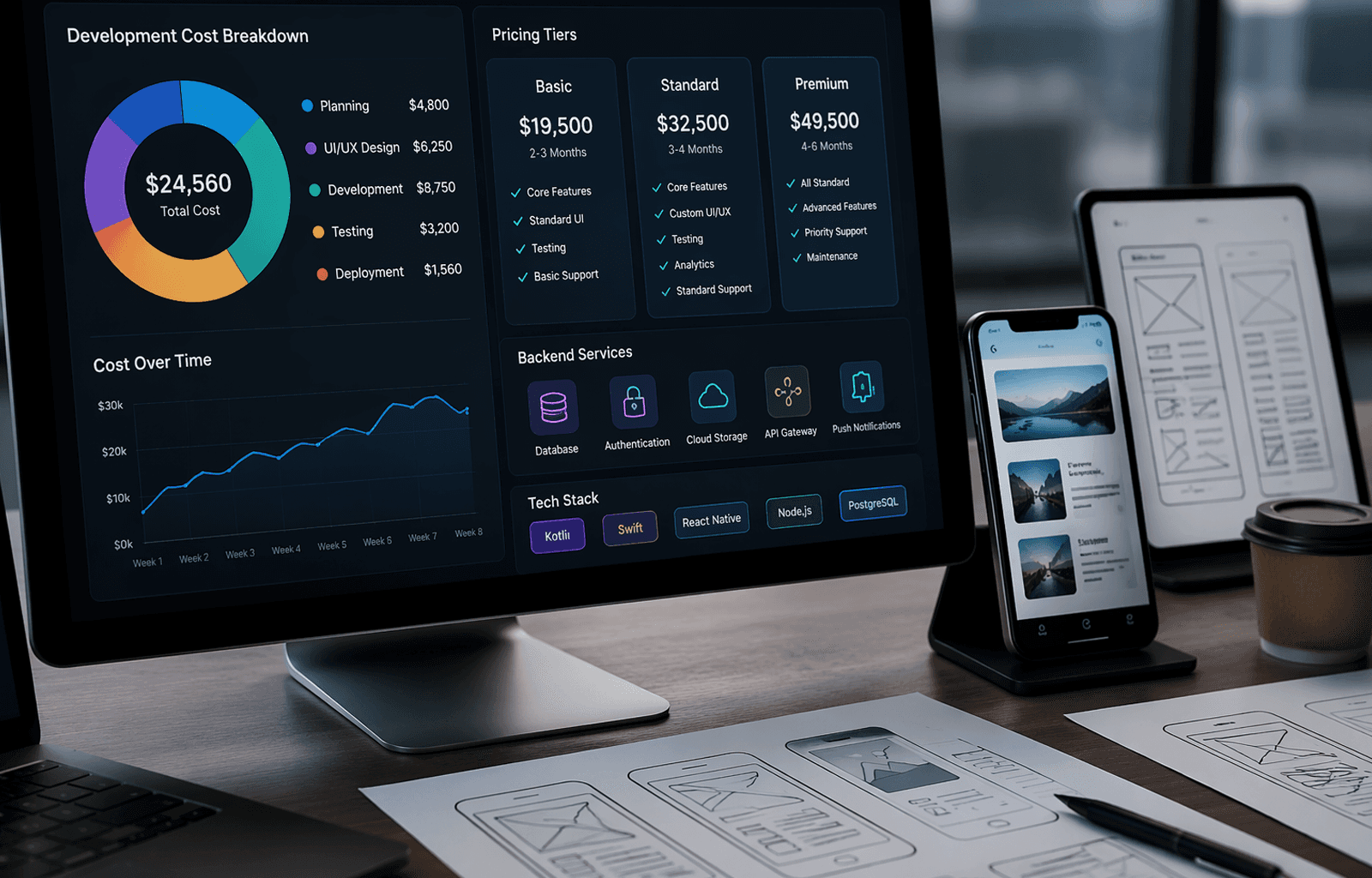
The cost of custom Android and iOS app development in 2026 depends on business goals, feature complexity, platform choice, UI/UX design, backend architecture, integrations, security, and post-launch maintenance.
For a business, a mobile app is more than a digital product. It can become a sales channel, customer service tool, internal operation system, loyalty platform, and business data source. That is why app cost estimation should start with business objectives, not with a generic feature list.
Custom Android and iOS App Cost Estimate in 2026
Most business apps can be grouped into the following pricing categories.
| App Type | Estimated Cost | Typical Features | Estimated Timeline |
|---|---|---|---|
| Simple app | $10,000 to $40,000 | Login, profile, catalog, forms, basic notifications | 1 to 2 months |
| Mid-level business app | $40,000 to $150,000 | Admin dashboard, payment, API, reports, push notifications | 2 to 4 months |
| Marketplace or on-demand app | $150,000 to $400,000 | Multi-user flow, transactions, tracking, chat, ratings, order management | 4 to 8 months |
| Enterprise app | $400,000+ | ERP integration, AI, large data, advanced security, multi-branch operations | 6 months or more |
These numbers are early estimates. A professional vendor still needs discovery, requirement analysis, and scope planning before giving a final quote.
Main Factors That Affect App Development Cost
1. Platform Choice
An Android-only app usually costs less than building for both Android and iOS. Businesses that need wider reach often choose cross-platform development with Flutter or React Native. One codebase can reduce development time and simplify maintenance.
2. Feature Complexity
Login and catalog features cost less than payment systems, live tracking, real-time chat, OCR, AI recommendations, subscriptions, or multi-vendor workflows. The more business logic an app needs, the higher the development cost.
3. UI/UX Design
A business app must be clear, fast, and easy to use. UI/UX cost includes user research, wireframes, prototypes, design systems, and usability testing. Strong design reduces development rework.
4. Backend and Database
A custom app needs a backend to store data, manage user roles, process transactions, and connect with other systems. A strong backend helps the app stay stable as users grow.
5. Third-Party Integrations
Payment gateways, maps, email, SMS OTP, CRM, ERP, POS, inventory systems, and messaging APIs can increase the budget. Every integration needs setup, testing, documentation, and data protection.
6. App Security
Security must be part of the budget. A business app needs encryption, API protection, input validation, access control, audit logs, and security testing. This is critical for finance, health, logistics, education, and enterprise apps.
Native vs Cross-Platform Development
Native development works best for apps that need high performance, complex device access, advanced animation, or strict platform-specific behavior. Android usually uses Kotlin. iOS usually uses Swift.
Cross-platform development works well for MVPs, business apps, e-commerce, booking systems, POS apps, delivery apps, and mobile dashboards. Flutter and React Native are popular because they can reduce delivery time and maintenance cost.
| Technology Choice | Main Benefit | Best For |
|---|---|---|
| Android Native | Strong Android performance | Android-only apps |
| iOS Native | Optimized Apple user experience | Premium iOS apps |
| Cross-Platform | Faster delivery for Android and iOS | MVPs, startups, SMEs, business apps |
Hidden App Development Costs
Many companies only calculate the initial development budget. A mobile app also needs ongoing costs after launch.
- Server and cloud hosting
- Monthly maintenance
- Bug fixes and OS updates
- Play Store and App Store publishing fees
- App performance monitoring
- Security audits
- New feature development
- Third-party API fees
A healthy maintenance budget should be planned from the start. This keeps the app stable, secure, and aligned with user needs.
How to Reduce App Cost Without Losing Quality
The best way to control cost is to build an MVP first. An MVP includes the core features that directly support the business goal. Avoid building every feature in the first release.
- Define the main problem the app must solve.
- Prioritize features that affect revenue or efficiency.
- Use cross-platform development when native performance is not required.
- Create a prototype before development.
- Prepare clear requirements.
- Choose a vendor with transparent scope, timeline, and pricing.
Checklist Before Requesting a Quote
Prepare the following details before asking for a proposal.
- Business goal
- Target users
- Required platforms
- Main features
- Reference apps
- Admin dashboard needs
- API integration needs
- Launch target
- Initial budget range
Conclusion
The cost of custom Android and iOS app development for business in 2026 depends on feature complexity, platform choice, design, backend, security, and integrations. A simple app can start from a modest budget. A complex enterprise app can require a much larger investment.
The best approach is to start with discovery, build an MVP, and scale features in phases. With the right strategy, a business can build a mobile app that is efficient, scalable, and ready for long-term growth.
FAQ
How much does a custom Android and iOS app cost?
A simple app can start from around $10,000. Complex business and enterprise apps can cost hundreds of thousands of dollars.
Is Flutter or React Native cheaper?
In many cases, cross-platform development is more cost-effective because one codebase can support both Android and iOS.
How long does it take to build a mobile app?
A simple app can take 1 to 2 months. A mid-level app may take 2 to 4 months. A complex app may take 6 months or more.
Is maintenance cost necessary?
Yes. Maintenance keeps the app secure, compatible, stable, and ready for future updates.