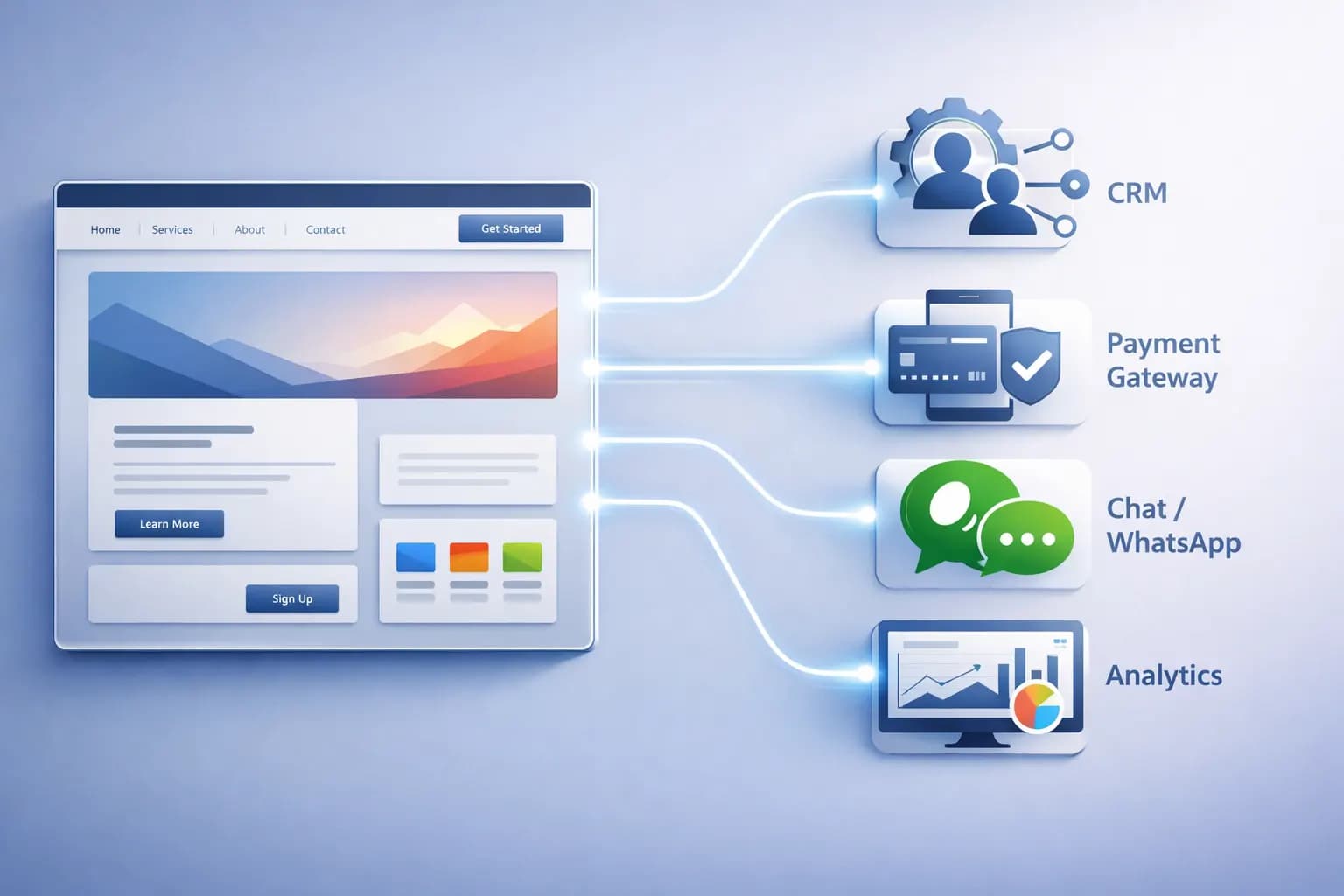
A landing page can look stunning and still fail as a growth engine. The usual culprit is not typography—it’s fragmentation: leads arrive but don’t reach sales fast enough, payments get verified manually, and analytics can’t explain what’s actually working. That’s where API integration for business applications turns a “page” into a system.
This article explains how to integrate APIs to connect a high-converting landing page with your CRM, payment gateway, messaging automation, and analytics tracking—so conversion rate optimization (CRO) becomes measurable, repeatable, and scalable.
What Is an API (and Why Businesses Should Care)?
An API (Application Programming Interface) is a structured way for software to communicate. Think of it as a contract: “If you send data in this format to this endpoint, you’ll get that response.” When your tools share APIs, you can move data automatically—no copy-paste, no spreadsheet chaos.
In business terms, API integration tends to deliver three outcomes: speed (faster workflows), accuracy (less human error), and scale (your process doesn’t break when volume grows).
Common symptoms of an unintegrated funnel
- Leads fill out the form, then wait hours (or days) for a response.
- Customer data is scattered across inboxes, chats, and disconnected tools.
- Payments require manual verification before fulfillment can begin.
- Marketing can’t clearly attribute revenue to campaigns and keywords.
If you’re investing in a landing page design service to generate demand, integration is what protects that investment—by ensuring every click has a clean path to revenue.
The Most Valuable API Integrations for Landing Page Conversion
You don’t need “all integrations.” You need the ones that remove friction in your specific funnel. Below are the most common integrations used in landing page optimization projects.
1) Landing Page → CRM (Instant Lead Capture)
The moment a visitor submits a form, the lead should appear in your CRM with the right metadata: campaign source, landing page variant, product interest, and priority level.
- Auto-assign leads to reps based on territory, product, or schedule.
- Auto-tag acquisition source (Google Ads, Meta, organic search, referrals).
- Auto-trigger reminders if a lead isn’t contacted within a defined SLA.
This is the foundation of speed-to-lead: the faster your response, the more likely the lead converts before attention decays.
2) CRM ↔ Messaging (WhatsApp/SMS/Email Automation)
Many conversions happen in conversation. API integration can personalize and automate the first steps: confirm the inquiry, deliver a tailored offer, or collect missing details—without forcing a rep to start from scratch.
A simple example: when a lead submits a “pricing request,” the system sends a message with a pre-filled context (name, plan selected, preferred schedule). The visitor feels seen; your team saves time.
3) Landing Page → Payments (Fewer Steps, Faster Revenue)
For bookings, deposits, digital products, or consultations, integrated payments reduce drop-off. Instead of “We’ll send payment instructions,” you can provide a secure checkout immediately.
- Create a payment link or checkout session on demand.
- Confirm success via webhook events.
- Automatically unlock access, reserve appointments, or trigger fulfillment.
4) Analytics & Conversion Tracking (So CRO Becomes Real)
You can’t optimize what you can’t measure. A CRO-ready setup typically includes:
- Event tracking: form submits, CTA clicks, scroll depth, checkout starts, purchases.
- Attribution hygiene: UTM parameters captured and stored with each lead.
- Dashboards: cost per lead, conversion rate by variant, revenue by channel.
When tracking is integrated properly, A/B testing becomes evidence-driven instead of opinion-driven.
How API Integration Works (Without the Headache)
Most modern integrations follow a few patterns. Understanding these helps you scope projects and avoid surprises.
1) REST APIs (Request–Response)
Your landing page sends a request to an endpoint (for example, “create lead”) and receives a response. REST is common because it’s simple, widely supported, and predictable.
2) Webhooks (Real-Time Events)
Webhooks notify your system when something happens—like a successful payment or subscription upgrade. Instead of repeatedly checking (“Did it happen yet?”), your system reacts instantly.
3) Middleware / Integration Layers
When you have multiple services, a middleware layer can centralize mapping, retries, logging, and routing. It’s often the difference between “it works on my laptop” and “it works reliably at scale.”
Reliability and Security: Integration Shouldn’t Become a Risk
Integration means data flows. Data flows should be protected. A professional implementation typically covers:
- HTTPS everywhere for all endpoints and callbacks.
- Authentication (API keys, OAuth) and secret management.
- Input validation to prevent garbage data and injection risks.
- Rate limiting to reduce abuse and accidental overload.
- Observability: logs, alerts, and retries for transient failures.
High-converting systems are not only persuasive—they are stable, fast, and trustworthy.
API Integration Meets CRO: Removing Friction at the System Level
Conversion rate optimization is fundamentally about reducing friction and increasing clarity. API integration helps at a deeper level than visual design: it streamlines the journey from intent to outcome.
Friction points integration can eliminate
- Long forms → reduce fields and enrich data later via CRM workflows.
- Manual payment confirmation → webhook-based updates in real time.
- Slow follow-up → instant lead routing and automated first-touch messages.
- Unclear next steps → personalized confirmation pages and sequences.
Behavioral models are helpful here: when you increase “ability” (make it easier) and deliver timely triggers, more users complete the desired action—even if motivation stays the same. Integration raises ability by removing steps.
Better A/B testing with better data
A/B tests become dramatically more useful when your events and outcomes are connected:
- Test messaging: headline and offer framing (impact on lead quality, not just volume).
- Test flows: chat-first vs form-first (impact on booked calls or paid orders).
- Test checkout: single-step vs multi-step (impact on completion rate).
Integration ensures your metrics reflect reality: lead, qualified lead, paid customer—end to end.
A Practical “Before vs After” Scenario
Consider a service business running ads to a landing page offering a free consultation. Without integration, inquiries sit in inboxes and follow-up is inconsistent. With API integration, the funnel becomes systematic:
Before
- Form submission → email notification.
- Manual spreadsheet entry.
- Manual outreach with inconsistent templates.
- No reliable attribution from campaign to revenue.
After
- Form submission → CRM lead created with UTM attribution.
- Auto-routing to the right rep + SLA timer.
- Instant confirmation message with scheduling link.
- Payment/deposit link generated when needed; webhook confirms payment.
- Dashboard shows conversion rate by campaign and landing page variant.
The result is typically fewer missed leads, faster sales cycles, and clearer decision-making on budget allocation.
Why a High-Converting Landing Page Must Be Mobile-First and Fast
Integration is the engine behind the scenes, but the landing page is still the front door. If that door is heavy (slow), confusing (unclear), or broken on mobile, conversion suffers.
What Code Hero Indonesia prioritizes
- Modern design that supports trust and comprehension.
- Mobile-first UX for ad-driven traffic.
- Page speed optimization to reduce drop-off.
- SEO-ready structure with clean headings, metadata, and schema where appropriate.
- Analytics tracking and event instrumentation for CRO.
- CRO iteration: audit → hypothesis → test → learn → improve.
A high-converting landing page is not just “designed.” It’s engineered—and integration is a major part of that engineering.
Implementation Checklist (So You Don’t Build Chaos Faster)
- Define the outcome: leads, booked calls, paid orders, subscriptions?
- Map the funnel: ad → page → follow-up → payment → fulfillment → retention.
- Choose the system of record: CRM first, then messaging, then payments.
- Design your tracking plan: events, attribution fields, and dashboards.
- Secure the flow: authentication, validation, and secrets management.
- Test end-to-end: simulate failures and recovery (retries, fallbacks).
- Document SOPs: what happens when an integration fails?
This checklist keeps integration aligned with business reality: reliability, clarity, and measurable performance.
Want a Landing Page That Connects to Your Business Systems?
Code Hero Indonesia builds conversion-focused landing pages that are mobile-first, SEO-ready, fast-loading, and designed for real-world performance—complete with analytics tracking, CRO optimization, and API integrations that connect your funnel end to end.
- Discovery session to map your funnel and identify the highest-impact integrations.
- Tracking plan and event instrumentation for measurable CRO.
- Implementation roadmap with realistic milestones.
Contact Code Hero Indonesia to request a consultation and project estimate.