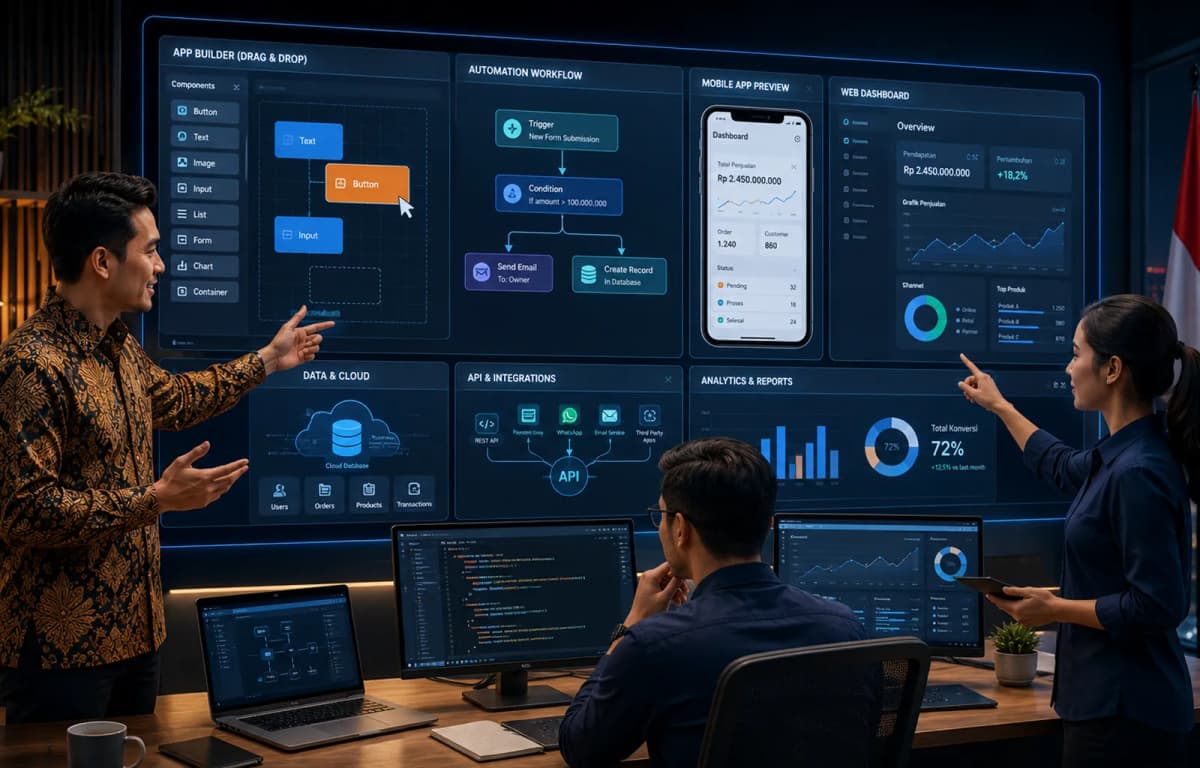
Business technology is entering a more demanding phase. Artificial intelligence is moving from chat interfaces into operational workflows. Cyber threats are becoming faster and more automated. Cloud costs require closer management. Customers expect connected digital experiences across websites, mobile apps, service channels, and physical locations. At the same time, leaders are under pressure to prove that technology spending improves revenue, productivity, resilience, or customer trust.
This environment changes the question business owners should ask. The goal is not to identify the most fashionable platform. The goal is to decide which business problem deserves investment, what data is required, which risks need controls, and how success will be measured. Technology should support a clear operating model rather than become another disconnected layer of software.
This guide examines nine business technology trends for 2026 that are already moving from experimentation toward practical adoption. Each section explains the business impact, common risks, useful applications, and a realistic starting point. The aim is to help leaders build a technology roadmap that is ambitious enough to create value and disciplined enough to remain secure, maintainable, and cost effective.
Why Technology Trends Matter to Business Owners in 2026
Technology now influences nearly every source of business value. It determines how quickly teams respond to customers, how accurately inventory is managed, how easily new services are launched, how securely information is stored, and how reliably leaders can interpret performance. Technology has also become a material cost category. Software subscriptions, cloud workloads, AI usage, data platforms, cybersecurity, and specialist talent all require active financial management.
The most important shift in 2026 is the move from software that assists people to systems that can complete parts of a workflow with limited supervision. AI can interpret instructions, retrieve context, call other applications, make recommendations, and trigger actions. This creates new productivity opportunities, but it also raises the cost of failure. An inaccurate answer is inconvenient. An autonomous action that changes a customer record, sends a payment, or modifies inventory can create a direct business impact.
For that reason, the strongest technology strategies combine innovation with governance. Security, data quality, user experience, observability, and human oversight need to be included from the beginning. Business owners should treat technology as a portfolio of capabilities with different levels of risk, maturity, and expected return.
Business Opportunity
Faster operations, lower administrative workload, better personalization, stronger decisions, and shorter digital product cycles.
Business Risk
Data exposure, uncontrolled cloud cost, vendor lock-in, weak integration, AI errors, cyber incidents, and low user adoption.
Success Factors
A defined problem, measurable outcomes, trusted data, scalable architecture, security by design, and role-based training.
Summary of the Top Business Technology Trends for 2026
| Trend | Primary Business Impact | Best Starting Point |
|---|---|---|
| Agentic AI | Automates connected tasks and decisions | Select one repetitive, low-risk workflow |
| Domain-specific AI | Improves relevance, accuracy, and control | Organize trusted internal knowledge |
| AI-native development | Accelerates application delivery | Define architecture, QA, and security standards |
| Preemptive cybersecurity | Reduces attack likelihood and impact | Inventory assets, identities, data, and vendors |
| Hybrid cloud and edge | Balances speed, scale, control, and cost | Classify workloads and sensitive data |
| Trusted data and provenance | Improves confidence in analytics and AI | Assign official sources and data owners |
| Physical AI and IoT | Connects digital intelligence to operations | Begin with monitoring and maintenance |
| API-first integration | Connects systems without replacing everything | Map data flows between applications |
| FinOps and efficiency | Links technology cost to business value | Measure cost per transaction or service |
Trend 1
Agentic AI and Multiagent Systems Enter Core Workflows
Earlier generations of business chatbots waited for a question and returned an answer. Agentic AI can work toward a goal. It can interpret instructions, break a task into steps, use approved tools, evaluate results, and request human input when needed. Multiagent systems distribute a complex workflow across specialized agents, such as a sales agent, document verification agent, risk agent, and reporting agent.
The strongest use cases involve repeatable processes with clear rules and high administrative effort. Examples include lead qualification, meeting follow-up, order validation, invoice matching, scheduling, recurring reports, customer onboarding, and service ticket routing. These applications can reduce cycle time and manual work, but they require defined boundaries.
A business should not give an AI agent unrestricted access to payments, customer data, pricing, or operational systems. Each action should have an authorization level. Low-risk actions can run automatically. Medium-risk actions can require confirmation. High-risk actions should remain under direct human control. Logs should record the instructions, data sources, tools used, decisions made, and final outcomes.
How to Start Safely
- Choose a repetitive, documented process with limited financial or regulatory risk.
- Define which actions the agent may complete and which actions require approval.
- Restrict access according to role and minimum operational need.
- Test edge cases, incomplete data, conflicting instructions, and system failures.
- Measure cycle time, error rate, cost per case, adoption, and user satisfaction.
A useful principle:
Do not automate a broken process. Clarify ownership, rules, exceptions, and metrics first. Then use AI to improve a workflow that the organization already understands.
Trend 2
Domain-Specific AI Replaces One-Size-Fits-All Implementations
General AI models are effective for writing, summarization, brainstorming, and broad research. Business operations often require more specialized knowledge. A healthcare provider, manufacturer, university, retailer, or logistics company has its own terminology, policies, product rules, risk thresholds, and documentation. Domain-specific models, smaller language models, and retrieval systems connected to verified internal knowledge are becoming more valuable in 2026.
Most companies do not need to train a foundation model from the beginning. A practical architecture can connect an existing model to approved information such as product catalogs, service policies, standard operating procedures, contracts, technical manuals, and support records. The system retrieves relevant context before generating an answer. This approach can improve relevance, reduce unsupported responses, and make updates easier.
Practical Business Applications
- Retail: product assistants that understand inventory, variants, promotions, delivery rules, and returns.
- Manufacturing: maintenance support that retrieves procedures and equipment history from symptoms.
- Education: student support grounded in curricula, academic calendars, and institutional policies.
- Professional services: document drafting and review based on controlled templates and internal standards.
The limiting factor is usually not the model. It is the quality of the knowledge base. Duplicate files, outdated policies, unclear ownership, and inconsistent naming will reduce performance. Before scaling domain-specific AI, create a content inventory, assign owners, remove obsolete material, define access rights, and establish version control.
Trend 3
AI-Native Software Development Speeds Up Digital Delivery
AI is now supporting coding, test generation, documentation, interface design, data migration, security review, and defect analysis. AI-native development platforms bring these capabilities into the software lifecycle. The business impact is not simply faster typing. Smaller teams can explore requirements, build prototypes, test alternatives, and improve features in shorter cycles.
Faster delivery also creates a new risk. Organizations can generate more software than they are able to govern or maintain. AI-generated code still requires review. Integrations still require testing. Applications still need access controls, monitoring, backups, documentation, and ownership. Business leaders should evaluate a digital product based on reliability, security, maintainability, user adoption, and total operating cost, not only launch speed.
Low-Code, AI-Assisted Coding, or Custom Software?
Low-code tools can be useful for simple workflows, internal forms, lightweight dashboards, and early prototypes. AI-assisted coding helps experienced developers complete technical work more efficiently. Custom software remains important when the system is a core business asset, requires complex integrations, handles sensitive data, or needs specialized performance and scalability. Many organizations will use a blended approach, validating an idea quickly and investing in custom architecture once the value and requirements are clear.
Questions to answer before building
- Which measurable business constraint will the application remove?
- Who are the primary users, and how do they work today?
- Which systems and data sources must be integrated?
- What information will be stored, and who may access it?
- Who will maintain the product after launch?
Trend 4
Cybersecurity Becomes Preemptive and AI-Aware
Traditional security programs often focus on blocking known threats and responding after an incident. In 2026, more organizations are moving toward preemptive cybersecurity. This approach combines threat intelligence, behavioral analytics, attack simulation, deception, automated controls, and continuous identity verification to reduce the chance that an attacker can reach valuable systems.
AI introduces additional security concerns. Sensitive information may be exposed through prompts. Employees may use unapproved AI tools. Agents may call systems outside their intended scope. Models may be influenced by prompt injection, malicious documents, or manipulated data. Businesses need an inventory of AI applications, approved use policies, vendor assessments, data filters, activity monitoring, and emergency shutdown procedures.
Minimum Security Controls for a Modern Business
- Multi-factor authentication for important accounts and administrative access.
- Role-based permissions with scheduled access reviews.
- Separated backups that are tested through recovery exercises.
- Regular updates for servers, applications, plugins, devices, and dependencies.
- Centralized logging, anomaly alerts, and a documented incident response plan.
- Phishing, password, and data handling training for employees.
- A clear list of approved AI tools and restricted data categories.
Cybersecurity should support growth rather than slow it down. Strong identity, data, and software controls make it easier to launch services, connect partners, satisfy customer requirements, and recover from disruption. Security is also a trust signal for customers, investors, and commercial partners.
Trend 5
Hybrid Cloud, Edge AI, and Data Sovereignty Shape Infrastructure
Cloud strategy is becoming more selective. Public cloud remains useful for elasticity, managed services, global reach, and rapid deployment. Private infrastructure or on-premise systems may be more appropriate for predictable workloads, legacy integration, specialized control, or sensitive data. Edge computing processes information close to a device or operating location, reducing latency and limiting dependence on constant connectivity.
Edge AI is especially relevant to companies with branches, warehouses, factories, clinics, farms, stores, vehicles, or field equipment. It can support visual inspection, queue analysis, machine monitoring, anomaly detection, safety alerts, and quality control. Not every video stream or sensor reading needs to be transferred to a central cloud platform. A local system can process the data and send only events or summaries that matter.
Use Four Criteria to Place Each Workload
A business does not need one infrastructure model for every system. A documented hybrid architecture can provide flexibility without unnecessary complexity. Multi-cloud should only be adopted when there is a clear resilience, commercial, regulatory, or capability reason. Using several providers without the skills and governance to operate them can increase risk rather than reduce it.
Trend 6
Real-Time Data, Knowledge Layers, and Digital Provenance
Many companies have large volumes of data but limited confidence in it. Sales figures differ between dashboards. Customer names are duplicated. Inventory updates arrive late. Reports depend on personal spreadsheets. These issues reduce the value of analytics and create a weak foundation for AI.
A knowledge layer connects data, definitions, business rules, documents, and process context. It helps people and AI use the same meaning for important concepts. Terms such as active customer, profitable order, delayed shipment, high-risk transaction, and qualified lead need an approved definition. Without common definitions, faster analytics can produce faster disagreement.
Digital provenance is also gaining attention. Organizations need to understand where data came from, how it changed, who owns it, which software components were used, and whether content was generated or modified by AI. Provenance supports auditability, cybersecurity, compliance, intellectual property management, and error investigation. Practical tools include metadata, version control, software bills of materials, attestations, digital signatures, watermarks, and change logs.
Foundational Steps for AI-Ready Data
- Identify the official source for customers, products, transactions, and inventory.
- Assign data owners who are responsible for definitions and quality.
- Remove duplicates and create unique identifiers for critical entities.
- Build integrations that update important information at the required speed.
- Record origin, version, permissions, and changes for sensitive data and content.
Trend 7
Physical AI, IoT, and Digital Twins Move Closer to Operations
Physical AI brings sensing, analysis, and action into cameras, machines, robots, vehicles, and connected equipment. For many companies, the most realistic starting point is not a general-purpose humanoid robot. Early value comes from sensors, machine vision, asset tracking, and operational analytics that help people make faster and more accurate decisions.
Examples include cold-chain temperature monitoring, visual defect detection, energy consumption analysis, fleet tracking, safety alerts, and predictive maintenance based on machine vibration. A digital twin creates a digital representation of an asset, facility, or process. It can help a business monitor current conditions, test scenarios, and identify potential disruption before changing the physical environment.
Physical AI requires close cooperation between technology, operations, engineering, safety, and security teams. Devices need lifecycle management. Network connections need protection. Sensor data needs filtering and calibration. Models must be validated under real operating conditions. The business also needs a manual fallback when an automated system becomes unavailable or uncertain.
Begin with visibility before full automation.
Use sensors and analytics to generate alerts first. Once accuracy, response procedures, safety, and financial value are proven, add automated actions in controlled stages.
Trend 8
API-First Architecture and Composable Business Platforms
A typical business may use a website, e-commerce platform, point-of-sale system, ERP, CRM, mobile app, payment gateway, analytics tool, and several spreadsheets. When these systems remain disconnected, employees re-enter data, reports arrive late, and customers receive inconsistent information. Technology strategies in 2026 increasingly favor APIs, events, and modular components that can be connected and replaced more easily.
API-first design means a system capability is built with clear rules for use by other applications. A composable platform allows the company to add or replace modules without rebuilding the entire digital environment. For example, a business can retain a stable inventory platform while connecting it to an online store, sales application, analytics dashboard, customer portal, and AI agent.
Business Benefits of Better Integration
- More consistent customer, product, and transaction data.
- Faster launch of new channels, features, and partnerships.
- Less manual data entry and fewer reconciliation errors.
- Lower switching risk when a vendor or module changes.
Integration requires governance. Every API needs authentication, usage limits, documentation, versioning, monitoring, and a named owner. Without these controls, the organization may replace spreadsheet complexity with a fragile network of undocumented connections.
Trend 9
FinOps, GreenOps, and Cost-Aware Computing
AI usage, cloud infrastructure, storage, observability, security services, and software subscriptions can grow quickly. Lower unit prices do not always reduce total spending because usage often expands faster. Businesses need to connect technology consumption to business outcomes.
FinOps brings finance, technology, and business teams together to manage cloud economics continuously. GreenOps adds attention to energy and resource efficiency. The goal is not simply to cut spending. The goal is to select the architecture, model, capacity, storage policy, and processing schedule that provides the required service level at a responsible cost.
Metrics More Useful Than the Total Monthly Bill
- Technology cost per order, active customer, transaction, branch, or service request.
- AI inference cost per task completed successfully.
- Percentage of resources that are idle, oversized, or have no owner.
- Cost of downtime and time required to restore service.
- Maintenance cost of legacy systems compared with staged modernization.
Common optimization methods include right-sizing, auto-scaling, scheduled shutdown of nonproduction environments, removal of unnecessary data, caching, smaller AI models, reserved capacity, and license consolidation. Decisions should be based on actual usage patterns rather than broad cost-cutting targets.
The Supporting Trend: AI Skills and Organizational Design
Technology adoption will remain limited when employees do not understand how to use, evaluate, and govern new systems. The workforce requirement for 2026 is broader than hiring AI specialists. Organizations need process owners who can describe a business problem, users who can evaluate outputs, developers who understand integration and security, and leaders who can define acceptable risk.
Training should be role based. Sales teams need safe methods for research, drafting, and follow-up. Operations teams need to interpret alerts and manage exceptions. Managers need to select use cases, calculate return, and understand control requirements. Technology teams need skills in identity, APIs, data governance, AI security, cloud operations, and observability.
Responsibility also needs to be explicit. When an AI system recommends or completes an action, the organization should be able to answer three questions: who approves the use case, who monitors performance, and who is accountable when the outcome is incorrect.
A 90-Day Roadmap for Technology Prioritization
A business does not need to adopt every technology trend at once. A short, structured roadmap can identify the best opportunity, prove value, and reduce risk before a larger investment.
Days 1 to 30: Map the Current State
- List processes that are slow, expensive, error prone, or difficult to measure.
- Map applications, data, integrations, vendors, and technology cost.
- Identify sensitive information and operational risk.
- Rank three opportunities by impact, feasibility, and risk.
Days 31 to 60: Run a Controlled Pilot
- Define a baseline, target, owner, users, and scope.
- Build a prototype with limited data and controlled access.
- Test normal scenarios, exceptions, load, and integration failure.
- Collect user feedback and record the full operating cost.
Days 61 to 90: Evaluate and Scale
- Compare outcomes with the baseline and target.
- Improve the process, documentation, security, and user experience.
- Decide whether to stop, revise, or expand the pilot.
- Create a 12-month roadmap aligned with capacity and business value.
Common Technology Investment Mistakes
Buying a tool before defining the problem
Technology without a specific use case adds cost, complexity, and user confusion.
Assuming existing data is ready for AI
Data needs definitions, ownership, access controls, quality standards, and context.
Ignoring maintenance and operations
Applications require monitoring, updates, backups, security patches, and continuous improvement.
Measuring activity instead of outcomes
Feature counts and logins are not enough. Measure time, cost, quality, revenue, adoption, and risk.
How PT Code Hero Indonesia Supports Digital Transformation
The technology trends shaping 2026 show that businesses need more than a standalone product. They need strategy, architecture, user experience, integration, security, and operational support that work together. PT Code Hero Indonesia helps SMEs, startups, institutions, and established companies turn business requirements into scalable digital solutions.
Services include professional website development, Android and iOS applications, custom software such as ERP and POS systems, UI/UX design, API integration, SEO, IT consulting, website maintenance, server maintenance, and technical support. The delivery process begins with discovery and strategy, followed by architecture and design, development and quality assurance, then launch and continuous optimization.
For companies considering AI, workflow automation, data dashboards, customer portals, operational applications, or legacy modernization, a structured technology assessment is the most useful first step. It separates essential capabilities from attractive but low-value features and creates a realistic plan for budget, security, integration, and growth.
Frequently Asked Questions About Technology Trends in 2026
Which technology trend is most important for businesses in 2026?
The priority depends on the business problem. Agentic AI, cybersecurity, data integration, hybrid cloud, and custom software have broad impact, but each investment should be evaluated through value, risk, data readiness, and organizational capability.
Should a small business use agentic AI?
A small business can begin with low-risk tasks such as conversation summaries, lead classification, first drafts, service routing, or recurring reports. Access should remain limited, and important actions should require human approval.
Is off-the-shelf software better than custom software?
Off-the-shelf software is efficient for standard processes. Custom software is more suitable when a workflow differentiates the business, needs complex integration, or requires specialized control. A hybrid approach is often the most practical.
How can a company measure digital transformation ROI?
Establish a baseline before implementation. Measure process time, cost per transaction, error rate, downtime, conversion, retention, productivity, and customer satisfaction. Compare the benefits with development, licensing, infrastructure, training, security, and maintenance costs.
What is the first step before adopting a new technology?
Map the problem, users, workflow, data, risks, existing systems, and desired outcome. Then run a limited pilot with clear metrics and a named owner.
Your Next Step
Build a Technology Roadmap That Fits Your Business
You do not need to adopt every trend today. Prioritize technology that removes a real constraint, produces measurable value, protects critical data, and fits your operating capacity. PT Code Hero Indonesia can help assess your needs and design, build, integrate, and maintain digital platforms that are ready to scale.
Explore PT Code Hero Indonesia Services