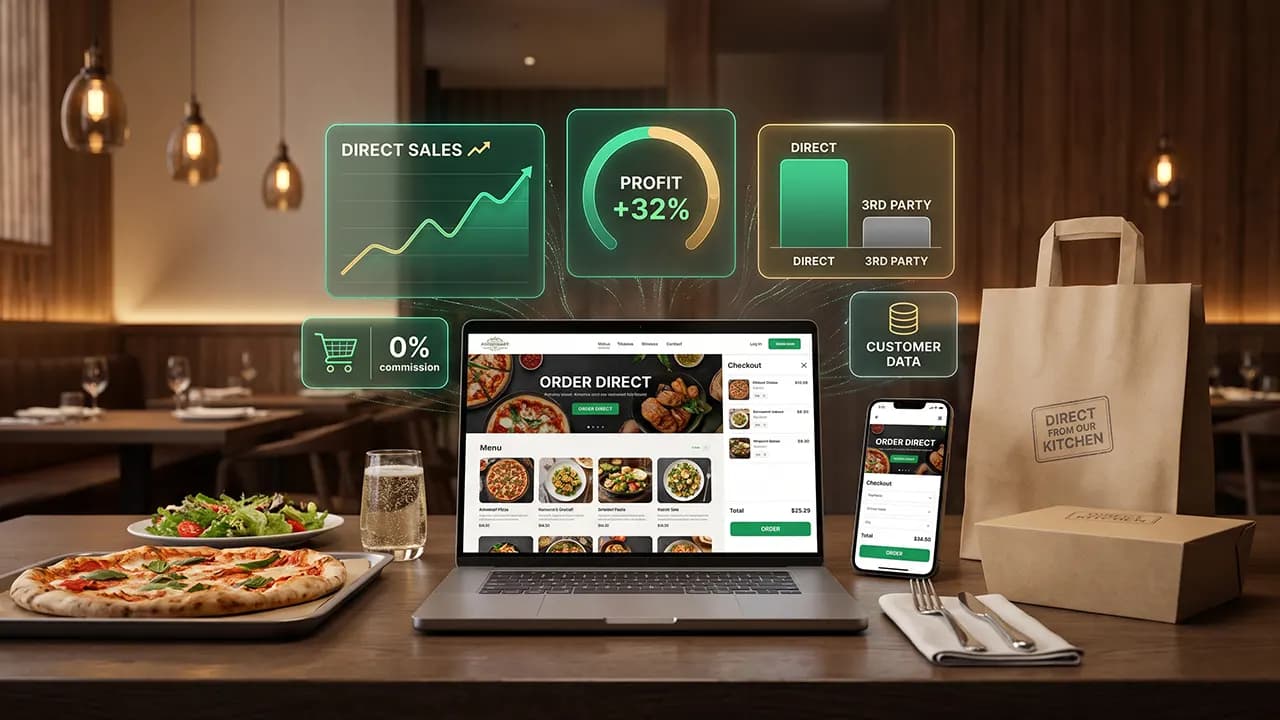
Discover how first-party online ordering helps restaurants manage transaction costs, improve profitability, build stronger customer relationships, and make smarter decisions through business data.
Restaurant Growth Is Not Just About Sales, It Is About Protecting Profit Margins
In the restaurant industry, increasing sales is an important business objective. However, higher order volumes do not automatically translate into higher profits. A restaurant may receive hundreds of online orders every day while experiencing pressure on its margins because of platform commissions, promotional expenses, packaging costs, payment processing fees, and delivery operations.
This challenge has become increasingly relevant as online food ordering continues to shape consumer behavior. Third-party delivery marketplaces provide restaurants with access to a large customer base, established delivery networks, promotional opportunities, and convenient ordering infrastructure.
These platforms can be valuable acquisition channels, especially for independent restaurants that do not yet have strong brand recognition. Nevertheless, relying entirely on third-party marketplaces can limit a restaurant's control over transaction costs, customer relationships, and the overall ordering experience.
This is where a restaurant direct ordering website becomes strategically important. By building an online ordering channel under their own brand, restaurants can provide customers with an alternative way to purchase food without routing every transaction through a third-party marketplace.
The objective is not necessarily to eliminate platforms such as DoorDash, Uber Eats, GrabFood, or GoFood. These services can continue to generate discovery and attract new customers. Instead, restaurants should develop a balanced channel strategy that combines marketplace visibility with direct customer relationships.
A well-designed direct ordering website can help restaurants improve contribution margins, strengthen customer loyalty, and gain better visibility into their business performance.
The Growing Food Delivery Market and the Challenge of Platform Costs
Online food delivery has become an established part of the global restaurant economy. The expansion of smartphones, digital payments, location-based services, and consumer demand for convenience has created new opportunities for restaurants to reach customers beyond their physical locations.
In Southeast Asia, the e-Conomy SEA 2026 report by Google, Temasek, and Bain & Company projects that the mobility and food delivery sector will reach US$40 billion in gross merchandise value (GMV) in 2026, representing 15% year-over-year growth.
Indonesia is an important market within this regional development. According to Momentum Works estimates reported by The Jakarta Post on January 28, 2026, Indonesia's online food delivery market generated approximately US$6.4 billion in GMV during 2025, an increase of around 18% compared with 2024.
These figures demonstrate the scale of digital food ordering opportunities. However, growing market activity also makes it important for restaurant owners to understand the financial structure of each sales channel.
Third-party ordering platforms may charge merchant service fees, promotional expenses, payment-related charges, and other costs according to their commercial agreements. The actual amount varies depending on the market, service model, merchant agreement, and applicable commercial conditions.
For example, Grab Indonesia's merchant terms, effective October 12, 2026, define the Service Fee by reference to the Commercial Terms and Conditions agreed with each merchant. The GoFood Merchant Help Center states that its service fee is calculated from each transaction's net sales. These provisions show why merchants should review their current agreements and settlement records rather than assume one standard fee applies to every restaurant.
Therefore, restaurant owners should not rely on generic commission percentages found online. They should review their own merchant agreements, settlement statements, promotional deductions, and payment costs before evaluating the profitability of each channel.
A direct ordering website provides another option. Rather than depending entirely on third-party transactions, restaurants can develop a first-party channel with a cost structure that they can evaluate and manage independently.
What Is a Restaurant Direct Ordering Website?
A restaurant direct ordering website is an online platform that allows customers to browse menus, select products, submit orders, and complete purchases directly through the restaurant's own digital channel.
Unlike third-party marketplaces that display multiple restaurants within a shared application, a first-party ordering website operates under the restaurant's own brand. The restaurant can manage its menu presentation, customer experience, ordering process, and administrative information.
A comprehensive restaurant online ordering website may include:
- Digital food and beverage menus.
- Product descriptions, photographs, and pricing.
- Shopping cart and order customization.
- Customer checkout and order information.
- Online payment gateway integration.
- WhatsApp ordering and confirmation.
- Dine-in, takeaway, and delivery options.
- Administrative product management.
- Order tracking and transaction reporting.
- Promotional campaigns and loyalty programs.
- Sales analytics and customer management features.
Consider a customer searching for a nearby restaurant through Google. After discovering the restaurant, the customer visits its website, reviews the menu, selects several items, and completes the order through the restaurant's checkout system.
The order can then be sent to the restaurant's administrative dashboard, point-of-sale system, or designated staff members for confirmation and preparation.
This makes the website more than an online brochure. It becomes a digital business channel that supports sales, customer communication, and operational management.
Why Direct Ordering Can Improve Restaurant Profit Margins
1. Reduce Dependence on Third-Party Marketplace Commissions
One of the most important financial advantages of first-party ordering is the ability to create an alternative to transactions that carry third-party marketplace service fees.
When customers order through a marketplace, restaurants receive settlement amounts after applicable deductions under their merchant agreements. With a direct ordering website, the cost structure may be different.
Restaurants may still pay payment processing fees, website infrastructure expenses, maintenance costs, and marketing expenses. However, direct transactions do not necessarily carry the same marketplace commission structure.
This can improve contribution margins, especially when a restaurant already has an established customer base and can generate repeat orders through its own website.
2. Gain Greater Control Over Pricing and Promotions
An independent ordering website gives restaurant owners greater flexibility when developing pricing strategies, meal combinations, promotional offers, and customer rewards.
For example, a restaurant may introduce a lunch package, a returning-customer discount, or a complementary beverage offer through its website. These promotions can be designed around specific business objectives rather than depending entirely on marketplace campaign structures.
However, pricing decisions should always consider ingredient costs, labor expenses, packaging, taxes, customer demand, and the restaurant's overall contribution margin.
3. Build Direct Customer Relationships
A restaurant's own website creates opportunities to maintain more consistent communication with customers. Guests interact with the restaurant's brand, ordering interface, product information, and service policies directly.
Where customers provide appropriate consent, restaurants can develop loyalty programs, personalized offers, and follow-up communication based on customer preferences and purchasing history.
Repeat customers are particularly valuable because businesses can build relationships over time instead of continuously relying on new customer acquisition.
A restaurant that understands customer preferences can provide more relevant recommendations, improve the overall experience, and encourage repeat purchases.
4. Gain Better Access to Customer and Sales Data
Direct ordering allows restaurants to record transaction information through systems they manage. This may include products purchased, order values, timestamps, payment status, customer purchase frequency, and ordering preferences.
These records can support product performance analysis, customer segmentation, promotional evaluation, and sales forecasting.
Instead of relying only on summary information provided by external platforms, restaurants can develop a more structured view of their first-party transactions.
5. Strengthen Brand Identity and Customer Trust
A restaurant website provides a dedicated environment for presenting its brand identity, location, menu, food photography, operating hours, and service information.
Customers can learn more about the business instead of seeing only a product listing within a large marketplace.
Consistent brand communication can support recognition, customer confidence, and long-term relationships, particularly when the website delivers a reliable ordering experience.
Do Restaurants Need to Replace Third-Party Delivery Platforms?
No. Building a direct ordering website does not mean abandoning every third-party marketplace. Both channels can serve different purposes within the same restaurant business.
Third-party marketplaces provide access to existing consumer audiences, restaurant discovery features, promotional opportunities, and established delivery infrastructure. These advantages can be particularly valuable when attracting customers who have never visited the restaurant before.
First-party ordering, on the other hand, provides greater control over the restaurant's own ordering experience and creates an opportunity to strengthen repeat business.
| Business Factor | Third-Party Marketplace | Own Website |
|---|---|---|
| Customer reach | Access to an established platform audience. | Built through SEO, advertising, and direct engagement. |
| Transaction costs | Subject to marketplace service fees and agreements. | Payment processing, infrastructure, and operating costs. |
| Brand control | Follows the marketplace interface. | Customized around the restaurant's brand. |
| Transaction data | Depends on platform reporting and access policies. | Can be managed through the restaurant's own system. |
| Customer relationships | Managed through marketplace mechanisms. | Can be developed through consent-based direct communication. |
| System management | Follows marketplace policies. | Managed by the restaurant or its technology partner. |
A balanced strategy is to use marketplaces for customer discovery and new customer acquisition while developing the restaurant website as a dedicated channel for direct transactions and repeat business. Customer communication and promotional activities should remain consistent with applicable platform terms.
How Much Can a Restaurant Potentially Save Through Direct Ordering?
Restaurant owners should evaluate the financial benefits of direct ordering using actual transaction data rather than general assumptions about marketplace commissions.
Consider an illustrative restaurant with an average order value of US$10. Assume that its merchant agreement applies a 20% marketplace service fee. The associated service fee would be US$2 per order.
Now assume that an equivalent direct order incurs a 2% payment processing cost, or US$0.20, together with US$0.50 in allocated website and marketing expenses.
Illustrative cost comparison per order
If the restaurant receives 500 comparable direct orders per month under these assumptions, the illustrative difference in the selected channel costs would be US$650.
These figures are hypothetical. The 20% marketplace fee is a scenario assumption, not a claim about a standard or current merchant rate. The calculation isolates the assumed marketplace fee and selected direct-channel costs. It does not establish net profit or model equivalent courier fulfillment, taxes, refunds, customer acquisition, and every operating expense. For a like-for-like comparison, restaurants should include the same service and fulfillment scope for both channels.
A complete evaluation should use the restaurant's actual merchant agreement, payment gateway charges, website hosting, software maintenance, customer acquisition costs, promotional expenses, packaging, taxes, refunds, and delivery fulfillment.
Delivery orders also require careful consideration of courier expenses. Dine-in and pickup transactions may have a different cost structure. The final decision should be based on contribution margin after all relevant variable costs are included.
Steps to Build a Restaurant Direct Ordering Website
Step 1: Understand the Restaurant's Business Model
Start by understanding how the restaurant receives and processes orders. Determine whether the website will support dine-in ordering, pickup, delivery, or all three.
Review the number of branches, menu categories, operating hours, customer profiles, kitchen capacity, and existing payment procedures. These details will help determine the appropriate website architecture and integration requirements.
Step 2: Collect Menu and Transaction Data
Gather menu information, product prices, photographs, variations, availability, and sales records from existing ordering channels.
Important information includes:
- Product names and unique identifiers.
- Current selling prices and discounted prices.
- Units sold and order quantities.
- Transaction values and timestamps.
- Sales channel information.
- Marketplace service fees and promotions.
- Packaging and delivery expenses.
- Payment and order completion status.
- Customer information where lawfully collected.
These records provide a baseline for evaluating the website after launch. Without historical information, it becomes difficult to determine whether the new channel actually improves business performance.
Step 3: Clean and Standardize the Information
Information from different platforms may use inconsistent product names, pricing formats, timestamps, and transaction identifiers. These differences should be corrected before analysis.
Data cleaning involves removing duplicate records, correcting inaccurate information, standardizing product identifiers, checking transaction completeness, and identifying missing values.
For example, if the same product appears as "Chicken Rice," "Rice Chicken," and "Grilled Chicken Rice," the restaurant should determine whether these entries represent one product or different variations. A consistent product identifier helps preserve historical sales accuracy.
Step 4: Define Measurable Performance Indicators
Before launching the website, establish measurable objectives. These may include increasing direct order share, reducing average transaction costs, improving conversion rates, increasing repeat purchases, or improving contribution margins.
Step 5: Develop the Website and Integrations
Build a responsive website that makes it easy for customers to browse menus, customize products, add items to their cart, enter delivery or table details, and complete payment.
Administrative functions should allow authorized employees to update products, prices, promotions, and order status. Additional integrations with POS systems, payment gateways, WhatsApp, and delivery management tools can be implemented according to operational requirements.
Step 6: Test and Launch Gradually
Test the complete customer journey, including product selection, checkout, payment, notifications, and transaction reporting. Start with a limited group of customers or one restaurant location before expanding the system across the business.
How to Collect Data from a Direct Ordering Website
Once the website is operational, restaurants should establish a consistent data collection process. Each customer interaction can provide useful information about ordering behavior and website performance.
Data can be collected through the website database, ordering system, payment gateway, analytics tools, and integrated point-of-sale software. Each source should have a clear event definition to avoid inconsistent reporting.
Useful data points include:
- Total website visitors and unique visitors.
- Product and category page views.
- Items added to shopping carts.
- Checkout sessions initiated.
- Orders successfully confirmed.
- Payments successfully completed.
- Average transaction value.
- Customer purchase frequency.
- Cancelled orders and refunds.
- Marketing and promotional expenses.
- Channel-level contribution margins.
It is important to distinguish between website visitors, potential buyers, confirmed orders, and completed transactions. A customer who visits a website does not necessarily purchase anything. Similarly, an order that has been submitted may not yet have been paid.
Tracking these events separately allows restaurant managers to understand the customer journey and identify where improvements are needed.
Cleaning Data Before Making Business Decisions
Collected information should be validated before it is used in financial reporting. Inaccurate records can lead to incorrect conclusions, particularly when comparing marketplace profitability with first-party transactions.
Start by identifying duplicate orders and payment records. A customer may submit the same order twice, or a system may record multiple payment notifications for one transaction. These situations require a consistent reconciliation process.
Next, identify cancelled orders, failed payments, and refunded transactions. These should not be treated as completed sales when calculating actual revenue.
Promotional expenses and marketplace deductions should also be recorded. A restaurant generating US$10,000 in gross sales does not necessarily receive US$10,000 in net proceeds. Service fees, merchant-funded discounts, refunds, and other expenses must be considered.
Customer information should be handled carefully. Avoid merging different customer records based only on similar names. Use appropriate identifiers and ensure that personal data is collected and processed on a lawful basis.
Restaurants operating in Indonesia should also consider Law No. 27 of 2022 on Personal Data Protection. The law recognizes several legal bases for processing personal data, so consent is not the only possible basis. Restaurants should identify the basis that applies to each purpose, explain how they use customer information, collect only what they need, protect access, set retention rules, and support data-subject rights. When a restaurant relies on consent for optional marketing communications, it should document that consent and provide a clear way to withdraw it.
Regular data cleaning and responsible data governance create a more reliable foundation for financial analysis and long-term business planning.
Essential Metrics for Measuring Direct Ordering Performance
Restaurant owners need measurable indicators to understand whether their direct ordering website is improving operational and financial performance.
| Metric | Calculation | Business Objective |
|---|---|---|
| Direct Order Share | Completed direct orders / completed orders across all channels × 100% | Measures first-party channel contribution. |
| Conversion Rate | Confirmed direct orders / eligible direct-order website sessions × 100% | Measures ordering effectiveness. |
| Average Order Value | Net merchandise sales from completed orders / completed orders | Measures average order value. |
| Cost per Order | Channel-attributable costs / completed orders | Measures order acquisition costs. |
| Contribution Margin | Net sales − variable costs | Measures transaction contribution. |
| Repeat Purchase Rate | Customers with 2+ completed orders / unique customers with 1+ completed order in the period × 100% | Measures customer retention. |
| Customer Acquisition Cost | Channel-attributable acquisition spend / new customers acquired through that channel | Measures customer acquisition efficiency. |
Restaurants can also calculate channel-level cost differences by comparing the actual expenses associated with equivalent orders. Include platform fees, payment processing, marketing, delivery, and operating costs. Use the same accounting treatment for discounts, refunds, taxes, and delivery charges across channels.
Keep metric definitions and measurement periods consistent. Exclude test orders, duplicate transactions, and bot traffic. For conversion rate, count confirmed orders rather than checkout button clicks, and state whether cancelled orders remain in the numerator. For average order value, define whether the calculation includes taxes and delivery charges. For repeat purchase rate, use a fixed period and count customers who made at least two completed purchases during that period.
Contribution margin is an amount. If managers also want to report a contribution margin rate, calculate contribution margin divided by net sales and multiply by 100%.
Reading Sales Patterns to Identify Cost-Saving Opportunities
Once the data has been cleaned and performance metrics have been defined, the next step is to identify patterns. The goal is not simply to discover which channel generates the highest sales volume, but to understand which channel provides the strongest financial contribution.
1. Analyze Sales by Ordering Channel
Compare marketplace, direct website, pickup, and dine-in performance. Examine transaction values, service fees, marketing expenses, and contribution margins. A channel with higher gross sales does not necessarily generate the highest profit contribution.
2. Analyze Ordering Times
Identify the periods when customers place the most orders. If direct website orders increase during lunch hours, restaurant managers can adjust staff schedules, ingredient preparation, and promotional campaigns accordingly.
3. Compare Best-Selling and Most Profitable Products
The most frequently purchased product is not necessarily the most profitable. Compare selling prices, ingredient costs, packaging, and channel-related expenses. Products with stronger contribution margins may deserve greater visibility within the website menu.
4. Understand Customer Purchasing Behavior
Identify new and returning customers, purchase frequency, favorite products, and responses to promotional offers. This information can help restaurants create loyalty programs that are relevant to actual customer preferences.
5. Identify Ordering Funnel Drop-Offs
If many visitors browse the website but fail to complete checkout, examine loading speed, additional fees, payment options, form complexity, and mobile navigation. Small usability problems can create significant lost sales opportunities.
Turning Data Insights into Profitable Business Actions
Data analysis becomes valuable when it leads to practical operational improvements. If a website receives substantial traffic but produces few transactions, improve the ordering experience and investigate customer concerns.
If customers frequently abandon their carts after seeing delivery charges, review the delivery pricing structure and make additional costs clear earlier in the ordering process.
If returning customers continue to order through marketplaces, strengthen direct brand communication through the restaurant website, social media, in-store materials, and appropriate loyalty initiatives.
When a product has a strong contribution margin, consider placing it more prominently on the website. If direct orders increase during specific periods, adjust employee responsibilities and kitchen preparation schedules.
Restaurants can also conduct controlled experiments. For example, test a new product photograph, a revised menu layout, or a different promotional message. Compare the results with a previous period while considering other factors that may affect sales.
The essential principle is to connect data, business problems, operational actions, and measurable results. A direct ordering website becomes more valuable when it supports a continuous improvement process.
Challenges Restaurants Should Consider Before Building Their Own Website
A first-party ordering website does not eliminate every transaction expense. Restaurants still need to budget for domain registration, hosting, software development, maintenance, payment processing, security, and digital marketing.
Another challenge is customer acquisition. Unlike established marketplaces, a new restaurant website does not automatically have access to a large existing consumer audience. Restaurants must invest in search engine optimization, local search visibility, social media, advertising, and other promotional activities.
Order fulfillment is equally important. If a website is not connected to the restaurant's existing operational workflow, employees may struggle to manage orders from multiple channels. Integration with POS systems, kitchen workflows, and delivery management can reduce this complexity.
Restaurants must also maintain website security, payment accuracy, customer privacy, database backups, and software updates. They should define who can access customer and transaction records, document retention periods, and review third-party integrations that process personal data.
These requirements should be included in the financial evaluation. The purpose of direct ordering is not simply to remove marketplace fees, but to establish a channel that produces better overall business value after all costs are considered.
A Practical 30-Day Restaurant Direct Ordering Implementation Plan
A phased implementation can help restaurants introduce direct ordering without disrupting their existing operations.
Week 1: Business Audit and Data Preparation
Review marketplace costs, transaction records, menu information, customer behavior, and existing order workflows. Define the website's objectives and essential features.
Week 2: Website Development
Develop the menu interface, shopping cart, checkout process, payment integration, WhatsApp communication, and administrative dashboard.
Week 3: Testing and Launch
Test product selection, payments, notifications, and transaction reporting. Train employees and introduce the website to customers.
Week 4: Performance Analysis and Optimization
Evaluate conversion rates, cost per order, contribution margins, and customer feedback. Implement improvements based on collected data.
How PT Code Hero Indonesia Supports Restaurant Website Development
Developing a restaurant direct ordering website requires more than creating an attractive interface. The website architecture, product information, checkout experience, payment integration, operational workflows, security, and reporting requirements must be considered together.
PT Code Hero Indonesia approaches restaurant website development by considering the specific operational requirements and business objectives of each client.
A family restaurant, independent cafe, cloud kitchen, food business, or multi-location restaurant may require different features and integration strategies. Therefore, the development process should begin with understanding the business model and identifying the problems that the website needs to solve.
Does the restaurant want to reduce channel costs? Improve repeat purchases? Manage multiple branches? Or gain better access to structured sales information?
These questions help determine the appropriate features, technology architecture, and implementation priorities.
Businesses exploring their own online ordering channel can learn more about restaurant website development services from PT Code Hero Indonesia. A properly planned website can provide a digital foundation for marketing, ordering, and restaurant operations.
Frequently Asked Questions About Restaurant Direct Ordering Websites
Can a direct ordering website replace DoorDash, Uber Eats, or other delivery platforms?
A direct ordering website can become an alternative sales channel, but it does not necessarily need to replace third-party marketplaces. Both channels can operate together with different business objectives.
Is ordering through a restaurant's own website completely free?
No. Restaurants still need to cover website development, hosting, maintenance, payment processing, marketing, and operational expenses. The advantage is greater control over the channel's cost structure.
Do customers need to download a mobile application?
No. A responsive direct ordering website can be accessed through a smartphone browser without requiring customers to install another application.
How can a restaurant determine whether direct ordering actually saves money?
Compare the total cost per completed order and contribution margin across different sales channels. Include platform fees, payment processing, marketing, delivery, and operational expenses.
Can a direct ordering website integrate with WhatsApp?
Yes. A website can use WhatsApp links for order confirmation and customer communication. More advanced integration can be developed according to operational requirements.
Is a direct ordering website suitable for small restaurants?
Yes. A small restaurant can begin with digital menus, a shopping cart, checkout functionality, and WhatsApp integration. Additional features can be introduced as the business grows.
Does direct ordering guarantee higher profit margins?
No. Direct ordering can reduce some marketplace-related costs, but it also creates expenses for customer acquisition, payment processing, website operations, and order fulfillment. Compare contribution margin per completed order across channels before deciding how much business to shift to the direct channel.
Stop Focusing Only on Sales. Build a Channel That Protects Your Profit.
In an increasingly competitive restaurant industry, sales growth must be supported by effective cost management and a sustainable profit strategy. Third-party marketplaces remain valuable for customer discovery, but depending entirely on external platforms can limit a restaurant's flexibility.
A direct ordering website gives restaurants the opportunity to build their own ordering channel, manage the customer experience, record transaction information, and evaluate business performance more systematically.
By collecting data, cleaning information, defining performance metrics, identifying patterns, and taking informed action, restaurant owners can develop a more measurable and sustainable digital business strategy.
Explore Restaurant Website Development