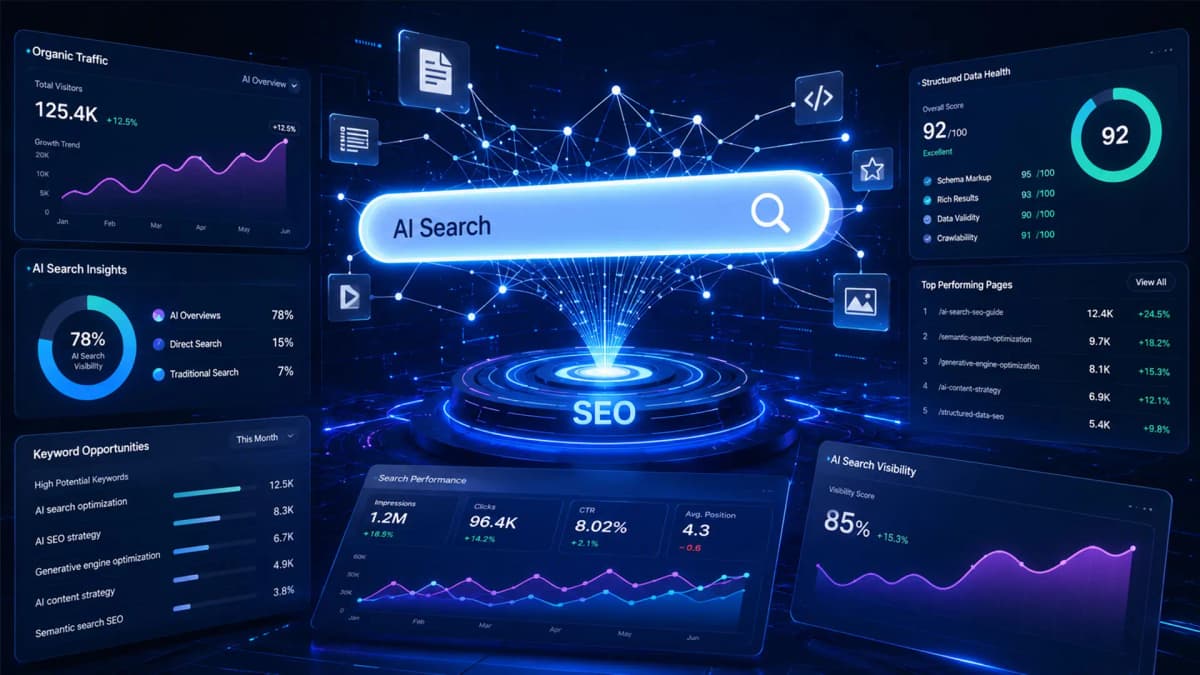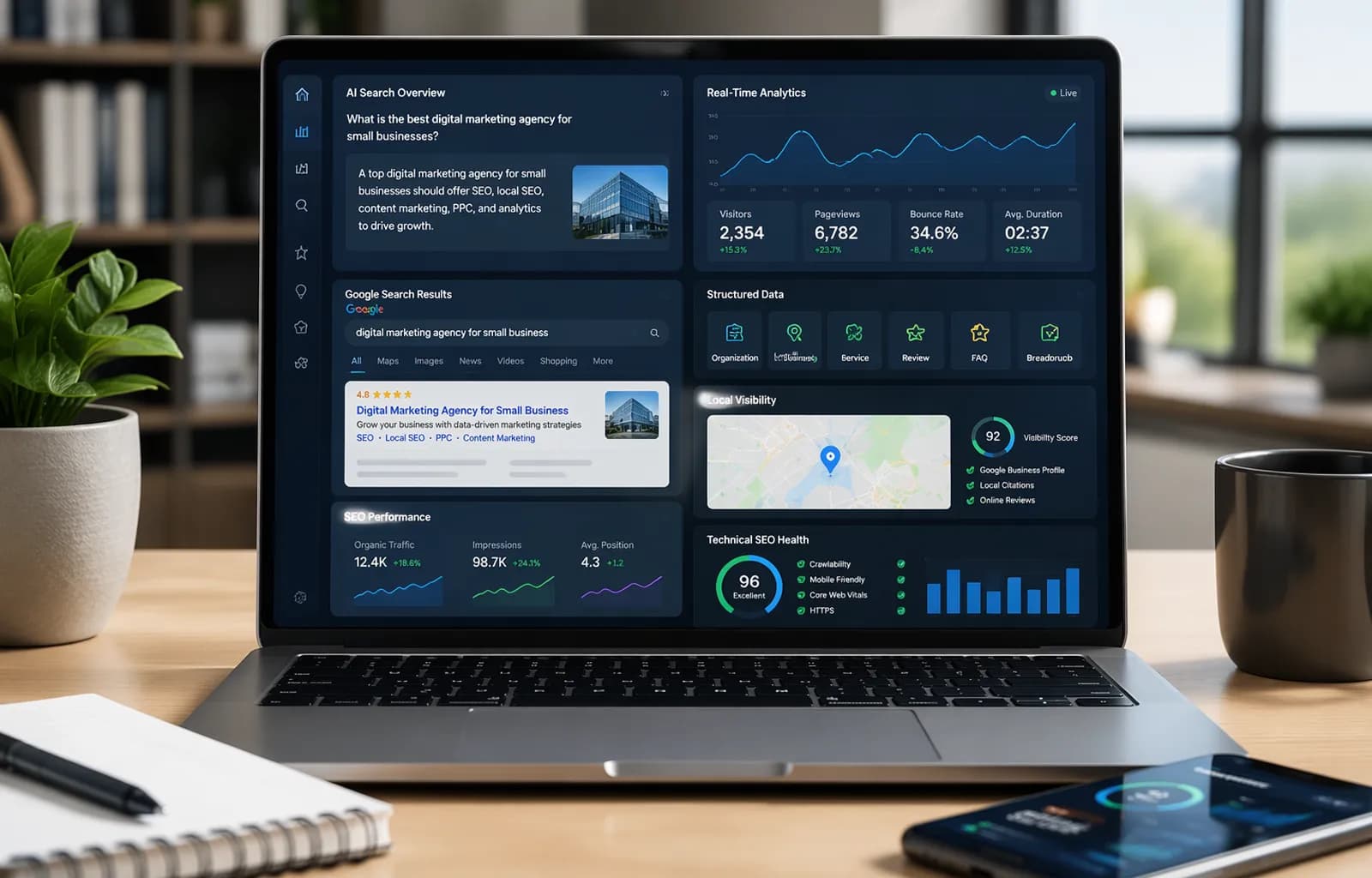
Business website optimization in 2026 is no longer only about ranking on Google. Your website must also be ready for AI Search, AI Overviews, and generative search results. This shift makes SEO more technical, more strategic, and more focused on user intent.
The main goal stays the same. Your website must be easy to find, easy to understand, and trustworthy. The difference is that search systems now evaluate more than keywords. They also assess context, authority, structure, and whether your content deserves to be used as a trusted answer.
Why Business Websites Need Google and AI Search Optimization
Customers no longer search only with short keywords such as “SEO agency” or “website design service”. They now use complete questions such as “best SEO agency for local businesses” or “how to choose a website design service that can rank on Google”.
This change means your website must answer real customer questions clearly. Your content must provide direct value. Your page structure must be clean. Your business details must be complete. Your website speed must also be strong so visitors stay long enough to read your offer.
1. Start with a Technical SEO Audit
Technical SEO is the foundation. Without a healthy technical structure, even strong content may fail to perform. Make sure Google can crawl, understand, and index your most important pages.
Check your XML sitemap, robots.txt, canonical URLs, index status, heading structure, page speed, mobile usability, internal links, and 404 errors. Use Google Search Console to see indexed pages, search queries, impressions, and technical issues that block performance.
Your business website must also be secure. Use HTTPS. Make sure your homepage, service pages, contact page, location page, and blog content are easy to access from the main navigation.
2. Research Keywords Based on Intent, Not Only Volume
High-volume keywords do not always bring qualified leads. For business websites, intent matters more. Choose keywords that show a real need, buying interest, or a specific problem your product or service can solve.
The primary keyword for this topic is “business website SEO”. Supporting keywords include “how to appear on Google”, “AI Search optimization”, “Google AI Overview SEO”, “technical SEO for business websites”, and “schema markup for SEO”.
Use a mix of informational, commercial, and local keywords. Informational keywords attract new readers. Commercial keywords bring prospects. Local keywords help your business appear for location-based searches.
3. Build Content That Answers Customer Questions
AI Search can understand content better when it is clear, specific, and well structured. Avoid generic articles that only repeat basic definitions. Write from experience, internal data, case studies, workflows, and real customer problems.
Every service page should answer key questions. What service do you offer? Who is it for? What problem does it solve? How does your process work? What is the estimated cost? What proof do you have? What should the customer do next?
Use short paragraphs. Add clear headings. Include lists, tables, FAQs, and summaries. This format helps readers scan the page and helps search systems identify the main answers.
4. Optimize Service Pages as Money Pages
Many business websites focus too much on blog articles and ignore service pages. This is a mistake. Service pages often carry the highest conversion potential.
Each service page should include a strong title tag, persuasive meta description, clear H1, benefit-driven copy, social proof, portfolio, testimonials, FAQs, calls to action, and internal links to supporting articles.
A strong service page structure includes:
- An H1 with the main service and target market.
- An opening paragraph that explains the customer problem.
- A benefit section that explains expected outcomes.
- A process section that explains how the work is done.
- A proof section with case studies, testimonials, or portfolio examples.
- An FAQ section that answers customer objections.
- A CTA that directs users to book a consultation or request a quote.
5. Use Structured Data and Schema Markup
Structured data helps search engines understand the type of information on a page. For a business website, use relevant schema types such as Organization, LocalBusiness, Product, Service, FAQPage, BreadcrumbList, Article, and Review when appropriate.
Schema markup is not a shortcut to rankings. However, it helps clarify page context. This matters for rich results, entity understanding, and visibility across modern search experiences.
6. Strengthen E-E-A-T
E-E-A-T stands for Experience, Expertise, Authoritativeness, and Trustworthiness. A business website must show real proof. Do not rely on claims alone.
Add author or expert profiles, business address, contact details, an about page, legal information, portfolio, case studies, testimonials, work methods, and relevant references. For local businesses, keep your NAP data consistent across your website, Google Business Profile, directories, and social channels.
7. Optimize for Local SEO
If your business serves a specific area, local SEO must be a priority. Create specific location pages. Do not publish thin and repetitive city pages. Each location page should include unique details such as service area, local client examples, local market needs, original images, and contact routes.
Complete your Google Business Profile. Add the right category, business hours, photos, products, services, website link, and regular posts. Ask real customers for honest reviews. Respond to reviews in a natural and professional tone.
8. Create Content Worth Citing in AI Search
AI Search tends to use content that provides direct and reliable answers. Add a short summary near the top of the article. Give concise answers after important headings. Use data, examples, and practical steps.
A strong format includes:
- A short definition.
- Practical steps.
- Common mistakes.
- Application examples.
- FAQs with concise answers.
This format helps both users and AI systems understand the main points without guessing the page intent.
9. Build Internal Links and Topical Authority
A strong website is not built from one article. Create content clusters. For business website SEO, supporting articles may include “how to do keyword research for business”, “technical SEO checklist”, “how to create service pages”, “local SEO for small businesses”, and “how to read Google Search Console data”.
Connect supporting articles to your main page. Use natural anchor text. Internal links help users find more information and help search engines understand relationships between pages.
10. Measure Performance and Improve Regularly
SEO is not a one-time task. Review performance every month. Track impressions, clicks, average position, CTR, pages with declining traffic, new queries, and pages that do not generate conversions.
Use the data to update content, improve titles, add FAQs, strengthen internal links, and close keyword gaps. If a page gets high impressions but low CTR, improve the title and meta description. If a page gets clicks but no leads, improve the CTA and offer.
Common Business Website SEO Mistakes
Common mistakes include chasing keywords without understanding intent, writing generic content, using clickbait titles, ignoring service pages, failing to update old content, and not tracking conversions.
Another major mistake is mass-producing content with no unique value. In 2026, business websites need real experience. Content that only repeats common information will struggle to compete in Google and AI Search.
Conclusion
Optimizing a business website for Google and AI Search in 2026 starts with technical SEO, intent-based keyword research, helpful content, structured data, local SEO, E-E-A-T, and regular analytics.
The goal is not only to rank. The real goal is to become a clear, credible, and useful source that customers and search systems can trust. If your website is fast, complete, trustworthy, and relevant, your chances of appearing in Google and AI Search become much stronger.
FAQ
What is business website optimization?
Business website optimization is the process of improving technical structure, content, keywords, user experience, and trust signals so a website can be found more easily on Google and AI search engines.
Is SEO still important in 2026?
Yes. SEO is still important because search engines and AI search features still need crawlable, understandable, and trustworthy content.
How can a website appear in AI Search?
Create clear, specific, credible, and well-structured content that answers user questions. Make sure your website can be indexed, has authority, and includes complete business information.
Is schema markup required?
No. Schema markup is not required, but it is strongly recommended. It helps search engines understand page context and can support rich result eligibility.
How long does business SEO take to show results?
Early results can appear within a few weeks to several months, depending on technical health, keyword competition, content quality, and domain authority.